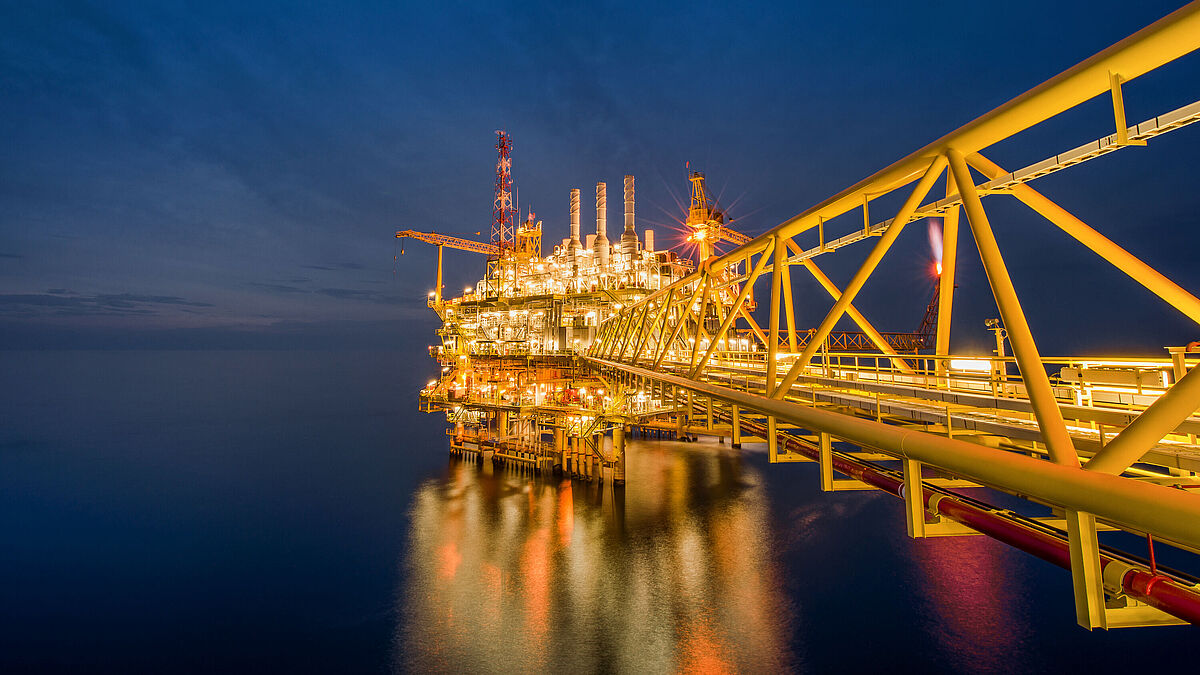
Underwater lightscapes are the focus of the international project ISOLUME, which is funded by JPI Oceans as part of the Joint Action “Changing Marine Lightscapes”. The lightscapes determine how deep sunlight is able to penetrate the sea, how plants photosynthesise, and how animals hunt or find their way. However, these lightscapes are becoming evermore imbalanced. Two developments are driving this change. Firstly: artificial lighting on the coasts, in ports, and towns. It shines far out to see and lights up the night. Secondly: the increasing murkiness of many coastal waters, which is also known as “coastal darkening”. Suspended particles, nutrients, and algal blooms obstruct the natural light. The water gets darker. Both are having a fundamental effect on marine living conditions. Some organisms lose their natural day-night rhythm. Others receive less light for photosynthesis. Food chains can alter and species can be suppressed. The consequences are complex – and currently only understood in part.
Cross-border research
This is where ISOLUME comes in. An international consortium with participants from several European countries is analysing historical data, performing field measurements, and developing models. The researchers are investigating how light conditions in various maritime regions have changed over long periods of time. They are asking: which physical processes play a role? What are the ecological effects? And which part is played by humans?
The project connects the natural and social sciences. It doesn’t only measure light intensity and water murkiness, but also takes a look at the political and legal frameworks. After all, artificial light is not a natural phenomenon, but the result of human decisions.
Legal loopholes in the regulation of light pollution
The University of Greifswald’s Institute of Energy, Environmental and Maritime Law (IfEUS) is playing a central in the assessment of legislation. Led by Prof. Dr. Sabine Schlacke, a subproject is investigating how national, European and international regulations approach light pollution. The research assistant Melina Bartmuß is analysing existing provisions and is searching for loopholes. “Up until now, environmental law has mainly concentrated on pollutants, noise or overfishing,” says Melina Bartmuß. “Legislation on light as a stress factor for marine ecosystems often remains vague.” The team from Greifswald wants to change this. Prof. Dr. Sabine Schlacke adds: “We are developing suggestions to help policymakers and authorities improve their management of artificial light – for example through stricter rules for coastal lighting, or the integration of new scientific findings in existing defence mechanisms.”
Further information
The ISOLUME project is being funded as part of JPI Oceans’ Joint Action “Changing Marine Lightscapes” and is financed by a joint call for proposals issued by national funding organisations. The funding period is from July 2025 to June 2028.
Germany, with its Leibniz Institute for Baltic Sea Research Warnemünde (IOW), is coordinating the project. Further project partners are the University of Plymouth and the Plymouth Marine Laboratory (United Kingdom), the Norwegian Institute for Water Research and the University of Bergen (Norway), the Institute of Oceanology at the Polish Academy of Sciences (Poland), the University of Galway (Ireland), and the University of Malta (Malta). Further information on the project
Contact at the University of Greifswald
Prof. Dr. Sabine Schlacke
Public Law: Administrative Law and Environmental Law
Institute of Energy, Environmental and Maritime Law (IfEUS)
Ernst-Lohmeyer-Platz 1, 17489 Greifswald
Tel: +49 3834 420 2100
sabine.schlackeuni-greifswaldde
Melina Bartmuß
Public Law: Administrative Law and Environmental Law
Ernst-Lohmeyer-Platz 1, 17489 Greifswald
melina.bartmussuni-greifswaldde