
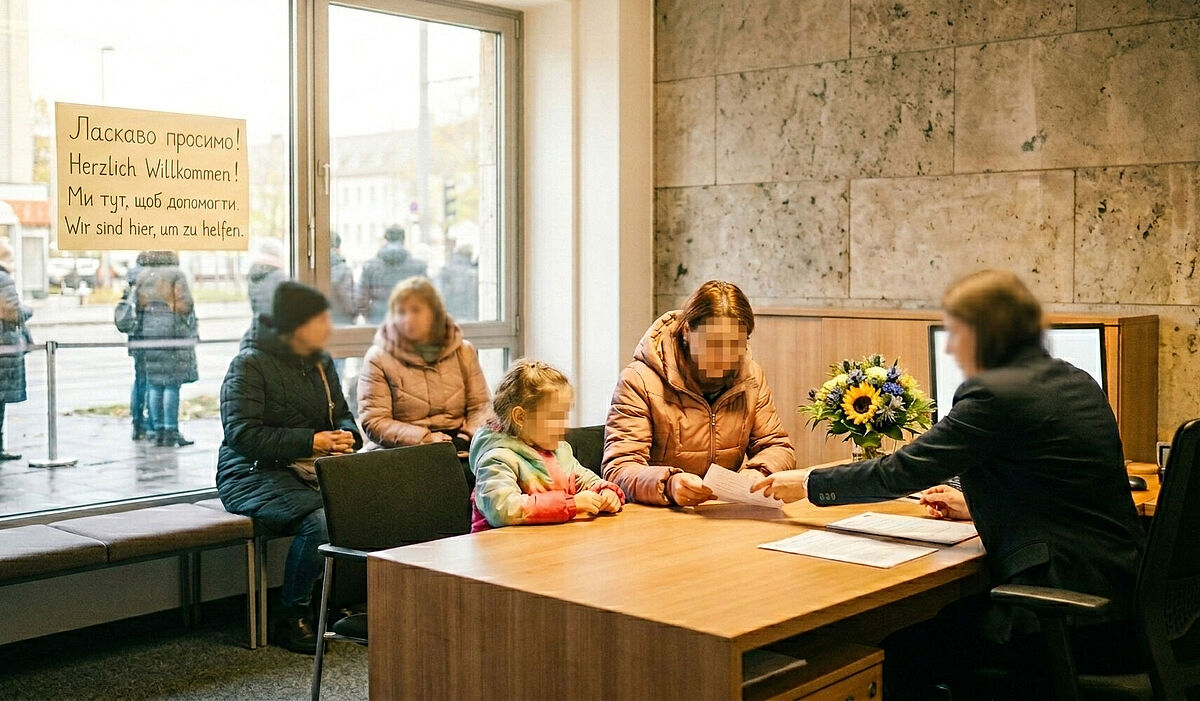
Russia's war of aggression against Ukraine has been ongoing for more than four years. Millions of people have sought refuge in the EU. Although their residence status has now been extended until the end of March 2028, access to language courses, housing, healthcare, and employment often remains difficult.
The key finding: whether refugees receive support often depends on the frontline workers at the authorities. Many employees compensate institutional shortcomings with their own personal efforts. They provide their personal phone numbers, work outside of normal office hours, or pay for necessary items out of their own pockets. At the same time, civil society organisations perform some of the tasks that government departments fail to fulfil sufficiently. Frontline workers in all six countries investigated in the study report feeling exhausted and experiencing significant psychological strain.
The researchers examined the situation in Germany, Sweden, Finland, Poland, Latvia, and Lithuania. The study is based on qualitative interviews and group discussions conducted in the six states between autumn 2025 and spring 2026. The analysis draws on information gathered from 17 focus groups with a total of 55 employees in labour market, housing, and education services; 73 interviews with Ukrainian refugees; and 18 interviews with people who returned to Ukraine following displacement.
The study reveals additional weaknesses: many well-educated Ukrainians are unable to find work that matches their qualifications. Furthermore, families come under pressure when parents plan to return home although their children have long since found their new home in the host country.
Lack of prospects for refugees
The lack of long-term perspectives beyond 2028 is particularly problematic. Although the EU has renewed the temporary protection for Ukrainian refugees, most member states lack specific regulations for the period to follow. This uncertainty makes it difficult to make long-term decisions—for refugees as well as for employers and public authorities.
The authors, Oksana Shmulyar Gréen and Andrea Spehar, therefore demand a guaranteed prospect of residence, uniform standards for public authorities, and better support for frontline workers. Civil society organisations also require permanent funding. In addition, they call for more individualised support services, faster procedures for recognising professional qualifications, and regulations that allow the people to travel back and forth between Ukraine and the host countries.
The key message of the study: integration must not depend on pure chance or the personal commitment of individual frontline workers. Instead, integration requires reliable political and institutional structures.
Further information
Policy Brief: Oksana Shmulyar Gréen and Andrea Spehar (2026). Improving Frontline Encounters with Displaced Ukrainians: Evidence and policy recommendations from the MAGnituDe project in Sweden, Germany, Latvia, Lithuania, Poland, and Finland. MAGnituDe Policy Brief. University of Greifswald / IFZO.
MAGnituDe: "Migration, Affective Geopolitics, and European Democracy in Times of Military Conflict" is a research and innovation project funded by the European Union as part of the "Horizon Europe" programme. Launched in February 2025, the project will run for 48 months, concluding in 2029. The project is coordinated by the University of Gothenburg in Sweden. The Interdisciplinary Centre for Baltic Sea Region Research (IFZO) at the University of Greifswald is contributing towards the project.
About the IFZO: The Interdisciplinary Centre for Baltic Sea Region Research (IFZO) conducts research into the history, the present, and future challenges of north-eastern Europe. The work focuses on the Baltic Sea region as a geographical and political whole characterised by a diversity of cultures, a unique ecosystem, and a considerable geopolitical significance.
Project: 101178269 – MAGnituDe – HORIZON-CL2-2024-DEMOCRACY-01
Contact at the University of Greifswald
Dr. Alexander Drost
Interdisciplinary Centre for Baltic Sea Region Research (IFZO)
Bahnhofstraße 51, 17489 Greifswald
Tel.: +49 3834 420 3341
alexander.drostuni-greifswaldde