Wetlands are among the most heavily altered ecosystems in Europe: more than half of their original area has been lost due to drainage, agriculture and the extraction of raw materials. However, until now, there has been a lack of comparable information across Europe to inform policy decisions regarding the location of the remaining ecosystems, their current condition and where their restoration could provide the greatest benefits.
First-ever Europe-wide high-resolution mapping
“To achieve the restoration targets for wetlands, we need a high-resolution map showing their extent, their different types and the pressures facing them today. Without this knowledge, it is almost impossible to assess their actual impact on the climate and biodiversity. Such a detailed map did not previously exist – but we have now succeeded in producing one that also shows how severely Europe’s wetlands are fragmented,” says lead author Dr. Gyula Máté Kovács from the Global Wetland Center at the University of Copenhagen.
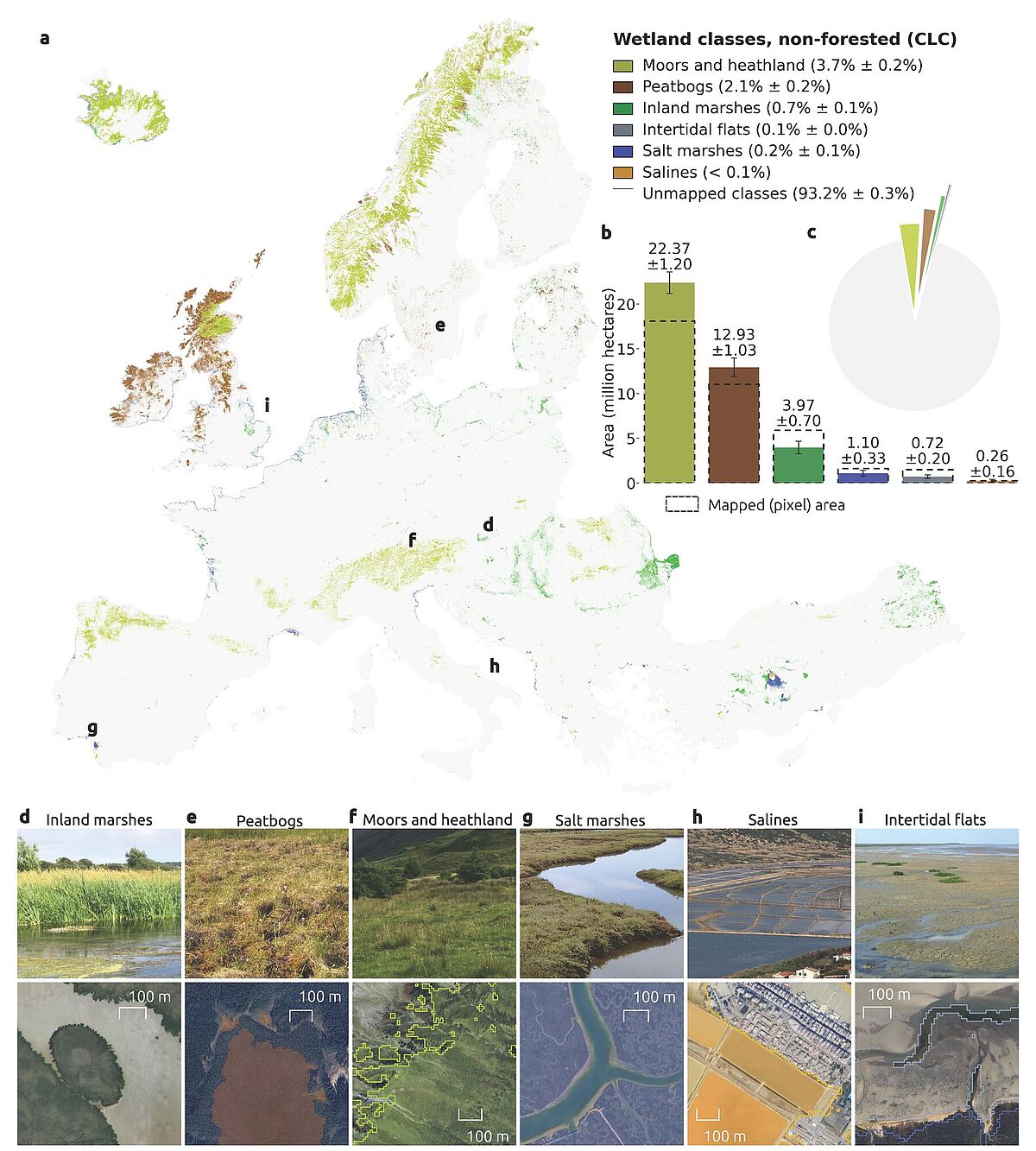
With the assistance of satellite data and machine learning methods, the research team mapped six types of natural and near-natural wetlands across 38 European countries. For the first time, the map provides a Europe-wide, standardised overview of the distribution, fragmentation and human impact on these ecosystems.
The analyses show that Europe’s wetlands are currently highly fragmented: many consist only of small, isolated remnant areas. Around one-fifth of the wetlands surveyed is significantly affected by human activities. Inland wetlands and peatlands are particularly affected.
Greifswald’s expertise on Europe’s wetlands and peatlands
The researchers from Greifswald contributed their expertise on peatlands, peatland inventories and European peatland policy to the study. In addition, they supported the development and validation of the Europe-wide mapping approaches. The work builds on research carried out by the Greifswald Mire Centre and the WETSCAPES2.0 Collaborative Research Centre, which are developing the scientific basis for the rewetting and sustainable use of peatlands.
Peatlands as the key to climate protection
Peatlands, in particular, play a central role in climate protection. They store large amounts of carbon over long periods of time, but can release significant quantities of greenhouse gases when drained.
“The restoration of wetlands poses major challenges for climate and biodiversity protection, but also for ensuring the availability of water in times of increasing droughts. With maps such as these, we can show in detail where the greatest potential lies across Europe for the protection of soil carbon and typical habitats in natural and near-natural wetlands,” says Sebastian van der Linden, Professor of Earth Observation at the University of Greifswald’s Institute of Geography and Geology and co-author of the study.
The study also provides comparable estimates of restoration needs in individual European countries. For Germany, it estimates a restoration requirement of around 106,000 hectares of near-natural wetlands by 2030. The findings can assist member states in drawing up their national restoration plans and help to document progress in a way that is comparable across Europe.
Further information
Publication: Kovács, G. M. et al. (2025): Highly fragmented European wetlands with uneven restoration needs. Nature.
Greifswald Mire Centre (GMC)
The Greifswald Mire Centre is a partnership between the University of Greifswald, the Michael Succow Foundation, DUENE e.V., and the Peatland Library Foundation. With around 150 peatland experts in one location, it is one of the world’s largest centres for peatland research. Acting as an interface between science, politics and practice, the GMC develops scientifically sound solutions to issues relating to climate, biodiversity and land use in connection with peatlands. The Global Peatland Database developed at the GMC provides a valuable data foundation for international analyses of peatland ecosystems.
Website
Collaborative Research Centre/Transregio 410 WETSCAPES2.0
The Collaborative Research Centre/Transregio 410 WETSCAPES2.0 is a research consort hosted by the University of Greifswald and the University of Rostock and is funded by the German Research Foundation (DFG). The focus is on interdisciplinary research into rewetted peatland landscapes. The aim is to provide a solid scientific basis to support both political and practical decision-making.
Website
Contact at the University of Greifswald
Luca Räther
Public Relations & Science Communication
Institute of Botany and Landscape Ecology
Soldmannstraße 15, 17489 Greifswald
Tel.: +49 3834 420 4135
luca.raetheruni-greifswaldde
Profile of Franziska Tanneberger
Profile of Gyula Mate Kovács (lead author; Global Wetland Center)
Website of the Earth Observation and Geoinformation Science Lab