
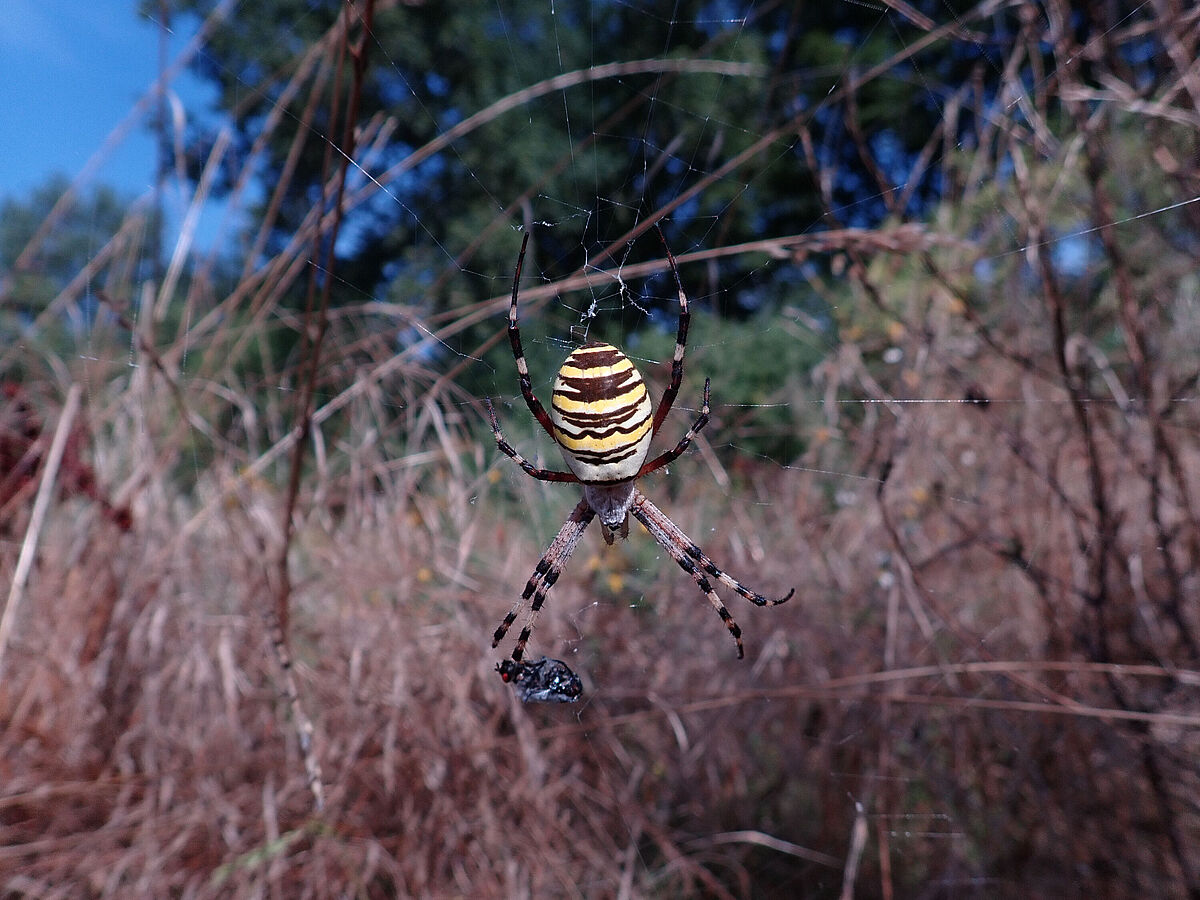
“In our study, we took a look at a species that has expanded its range faster than can be explained solely by climate change. We can learn from such species about the mechanisms that are responsible for rapid dispersal, even across various climatic zones,” says Prof. Dr Gabriele Uhl, Head of the General and Systematic Zoology Lab at the University of Greifswald’s Zoological Institute and Museum.
The study focuses around the question as to how organisms react to changing environmental conditions. Various mechanisms are possible: genetic adaptation as a result of random, advantageous mutations, migration to suitable habitats, or – if neither is possible – the local extinction of populations or species. The so-called phenotypic plasticity, i.e. the ability of individuals to change their features depending on environmental conditions – without changing their genetic makeup – also plays an important role.
The research team led by Prof. Dr Gabriele Uhl and lead author Dr. Monica M. Sheffer from the University of Greifswald examined wasp spiders from different European regions and combined genetic analyses with ecological, morphological, and physiological investigations across several development stages. In addition, they performed experiments in controlled conditions that simulated winter conditions from northern and southern habitats, in order to investigate how the animals from each of the regions differed in their reaction.
Two genetic groups – divided by a fine line
A central result: the populations of the wasp spider can be divided into two genetic groups, which are divided by a surprisingly fine line that runs diagonally through central Germany. This genetic separation corresponds to climatic differences, especially in winter.
“Our results show that genetic differentiation can take place significantly faster than previously assumed,” says Prof. Uhl. The investigations also demonstrate differences in the tolerance of the cold, development and reproduction rates of the northern and southern populations. Some of these differences are genetic. At the same time, the species exhibits a high amount of phenotypic plasticity, which aids its range expansion.
Significance for climate research
The study underlines how important it is to examine various stages of life and biological traits together in order to understand adaptation processes. This is particularly relevant in light of global climate change.
Recent follow-up studies also show that warmer winters in the Mediterranean region can have negative effects on the survival chances of the offspring. In the long term, this could even lead to the species’ retreat from its original range.
The results of further investigations suggest that temperature conditions in autumn can influence the survival chances and condition of the animals several months later – so-called long-term “spill-over effects” that have not been researched in detail so far.
Further information
The work was produced within the framework of the research training group RESPONSE with close collaboration between various research groups at the University of Greifswald, as well as partners in Germany and the US. The project was led by Prof. Dr. Gabriele Uhl, with significant input provided by doctoral candidate Monica M. Sheffer.
Sheffer, Monica M., Brian Schulze, Linda Zander, Pierick Mouginot, Thomas Naef, Michael Lalk, Martina Wurster et al. 2026. "Rapid Ecological and Evolutionary Divergence during a Poleward Range Expansion." Ecological Monographs. https://doi.org/10.1002/ecm.70047
Open-Access publication: https://unpaywall.org/products/extension
Contact at the University of Greifswald
Prof. Dr Gabriele Uhl
Zoological Institute and Museum
Loitzer Str. 26, 17489 Greifswald
Tel.: +49 3834 420 4242
gabriele.uhluni-greifswaldde