
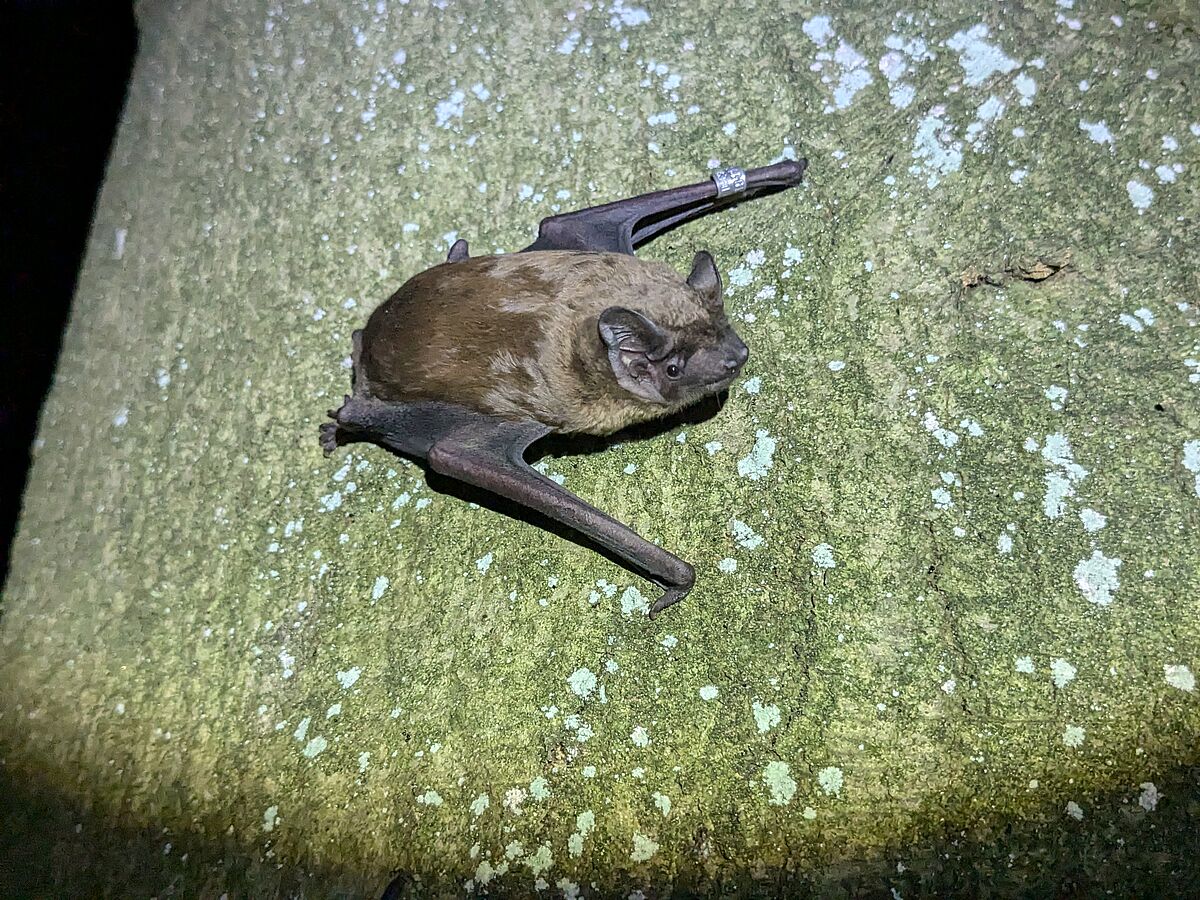
Several hundred animals were studied at four sites in north-eastern Germany – near Havelberg in Sachsen-Anhalt, near Greifswald in Mecklenburg-Vorpommern, and at two further sites in Brandenburg. The studies were carried out in old, structurally rich forests with many tree hollows and bat boxes.
“Our data provides several independent markers that suggest that reproductive processes continue to take place in spring,” says lead author Xenia Mathgen, who carried out the study as part of her master’s thesis at the University of Greifswald. “This means that the autumn mating season is not the only relevant period. Mating behaviour is significantly more flexible than previously thought,” explains Mathgen.
Several biological markers suggest activity
The research team examined the animals’ reproductive organs, hormonal characteristics and cytological samples. Sperm were still detectable in the epididymis of many of the examined male bats in spring. At the same time, both sexes displayed swollen cheek glands, which play a role in communication during the mating season.
The investigations also revealed evidence of reproductive activity in the females: sperm were detected in vaginal smears, even though many of the animals had not yet reached the ovulation phase in March.
“When these findings are combined, they point towards active mating behaviour after hibernation,” explains Dr. Marcus Fritze from the University of Greifswald, Department of Applied Zoology and Nature Conservation. “Spring may represent a kind of ‘last chance’ if mating has not been successful in the autumn, or if lower-ranking males try to grasp the opportunity they missed in the autumn.”
Significance for habitats and nature conservation
The findings highlight the importance of old forests with plenty of hollows as key habitats and breeding grounds for the common noctule. These forests not only provide shelters for hibernation, but also structures that are essential for reproduction.
Although bat boxes can supplement natural tree hollows, they are no substitute for a complete forest habitat. Peter Busse, who has many years of experience as a bat conservationist, looks after a large bat box site in the Havelberg Forest and emphasises: “We have known for some time how important these forests are for the common noctule. If these natural habitats are lost, the animals lose far more than just somewhere to sleep.”
Significance in the context of climate change
The results suggest that the reproductive cycle of the common noctule may be more flexible than previously assumed. Such adaptability could be an advantage in times of climate change. At the same time, the study highlights the importance of stable habitats for the conservation of species. “Improving our understanding of reproductive biology is a key foundation for effective bat conservation,” emphasises Fritze. “Only if we know when and where reproduction actually takes place can we effectively implement conservation measures.”
Further information
Publication: Mathgen, X., Busse, P., Fasel, N. J., Kravchenko, K., Scheuerlein, A., Holtze, S., Fritze, M. (2026): Reproductive timing in bats: evidence of spring mating following hibernation. Mammalian Biology, 15 April 26. https://doi.org/10.1007/s42991-026-00581-8
Contact at the University of Greifswald
Dr. Marcus Fritze
Competence Centre for Bat Conservation
c/o Biosphere Reserve Karstlandschaft Südharz
Hallesche Straße 68A, 06536 Roßla
Tel.: +49 1511 8838514
marcus.fritzebiores.mwu.sachsen-anhaltde
marcus.fritzeuni-greifswaldde