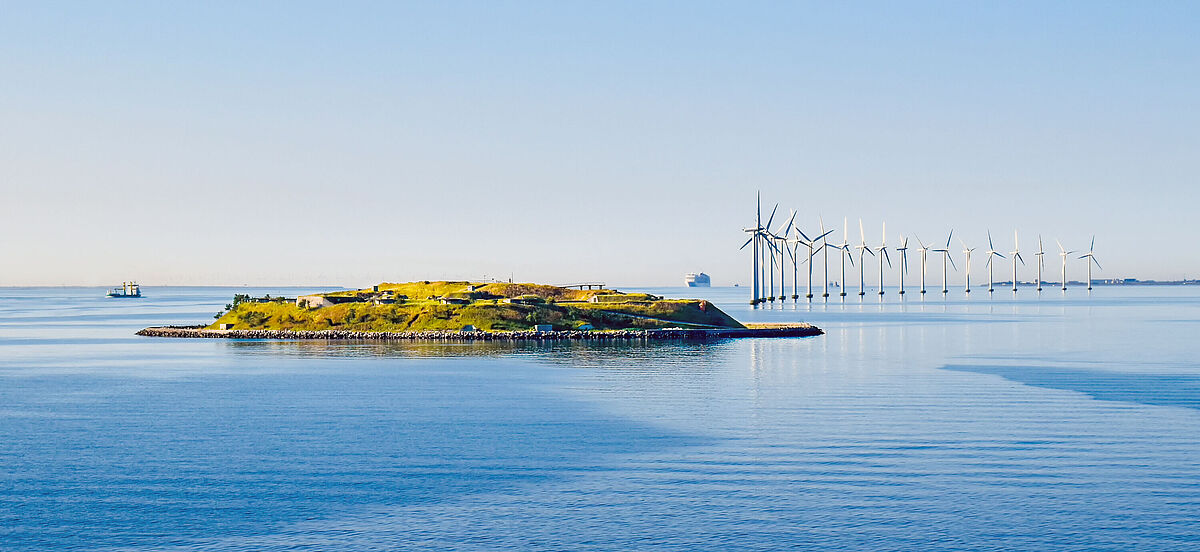
The Baltic Sea connects countries with a long history of trade, cultural exchange, and political conflicts. They are now faced with joint tasks: they must strengthen their security, reorganise their energy supply, and protect the marine environment. That said, national interests and different political approaches are making this collaboration difficult.
Security policy after the end of the Cold War
In the Middle Ages, the trading of the Hanseatic League linked many towns on the shores of the Baltic Sea. In the 20th century, the Iron Curtain split the region into two political systems. After 1990, European integration was meant to bring the countries closer together. But rates of economic and political change varied. The history, culture, and how the change was experienced still shape the countries to this day; some previously socialist states felt they were not being treated as equal partners by the West.
Russia’s war on Ukraine has now returned the focus to security policies. The NATO expansion has strengthened collaboration. However, the countries need to improve their coordination of transportation routes, infrastructure, and processes to ensure that the armed forces are capable of crossing borders quickly if needs arise.
Energy: joint goals, different strategies
The war has raised awareness of the dependence on energy imports and the required guarantee of the energy supply. At the same time, the states need to reduce their greenhouse gas emissions. Joint electricity grids and plans for a hydrogen corridor could improve the supply. But the countries are adopting different solutions: some are planning to use nuclear power, others LNG or hydrogen. Legal frameworks and political goals also differ. It will be difficult to set up a joint supply of energy if regulations and energy grids remain incompatible.
Access to services remains crucial to rural regions
It is difficult to permanently finance bus connections, doctors’ practices, and other public services in sparsely populated regions. How well this works also depends on the tasks that local authorities are willing to perform and how much money they are able to spend.
EU programmes such as LEADER support local development projects. However, they only partially compensate the differences between the individual countries. Shared funding does not automatically create equal living conditions.
Joint efforts to protect the Baltic Sea
Fish populations, marine pollution and climate-caused effects do not stop at international borders. That is why the countries bordering the Baltic Sea need to coordinate their protection measures. These include the protection of fish populations, use of renewable energies, and the rewetting of peatlands. The population also needs to understand how their actions influence the Baltic Sea. The concept of “Baltic Sea Literacy” describes the local knowledge held by the people living beside the Baltic Sea about their ecosystem, its dangers and protection, and underlines how important it is to pass this knowledge on.
The history remains controversial
Historical finds and monuments also shape the identity of the region. The golden treasure of Hiddensee, for example, is not valued solely on the basis of its origin. Social perceptions and political interests influence how it is interpreted and exhibited. Monuments are similarly controversial: what some see as a sign of tradition may be associated with oppression by others. The way we deal with such places of remembrance shows that history can still shape political conflicts of today.
Collaboration requires specific steps
“The Baltic Sea region is a zone of joint interests, but the individual countries are headed in their own direction,” summarises Dr. Alexander Drost, Academic Manager of the IFZO. “When it comes to security policy, the war is bringing the states closer together. Yet, on the other hand, different energy plans are making it difficult to find joint solutions.” Shared goals alone also fail to provide the required environmental protection and development of rural regions. It will prove decisive whether the countries bordering the Baltic Sea are able to coordinate their plans for transport infrastructure, energy grids, public offers, and environmental protection. Only then will joint challenges be met with joint solutions.
Further information
Publication: Challenges of the Baltic Sea Region. Fragmentation and Harmonisation in Transformation Processes. Edited by Margit Bussmann, Alexander Drost, Steffen Fleßa, and Sebastian van der Linden. Rombach Wissenschaft, 1st Edition 2026, 248 pages. The work is part of the series “Studies of the Baltic Sea Region”.
About the IFZO: The Interdisciplinary Centre for Baltic Sea Region Research (IFZO) conducts research into the history, the present, and future challenges of north-eastern Europe. The work focuses on the Baltic Sea region as a geographical and political whole characterised by a diversity of cultures, a unique ecosystem, and a considerable geopolitical significance.
It is funded by the Federal Ministry for Research, Technology and Space (BMFTR) under grant number 01UC2102.
Contact at the University of Greifswald
Dr. Alexander Drost
Interdisciplinary Centre for Baltic Sea Region Research (IFZO)
Bahnhofstraße 51, 17489 Greifswald
Tel.: +49 3834 420 3341
alexander.drostuni-greifswaldde