
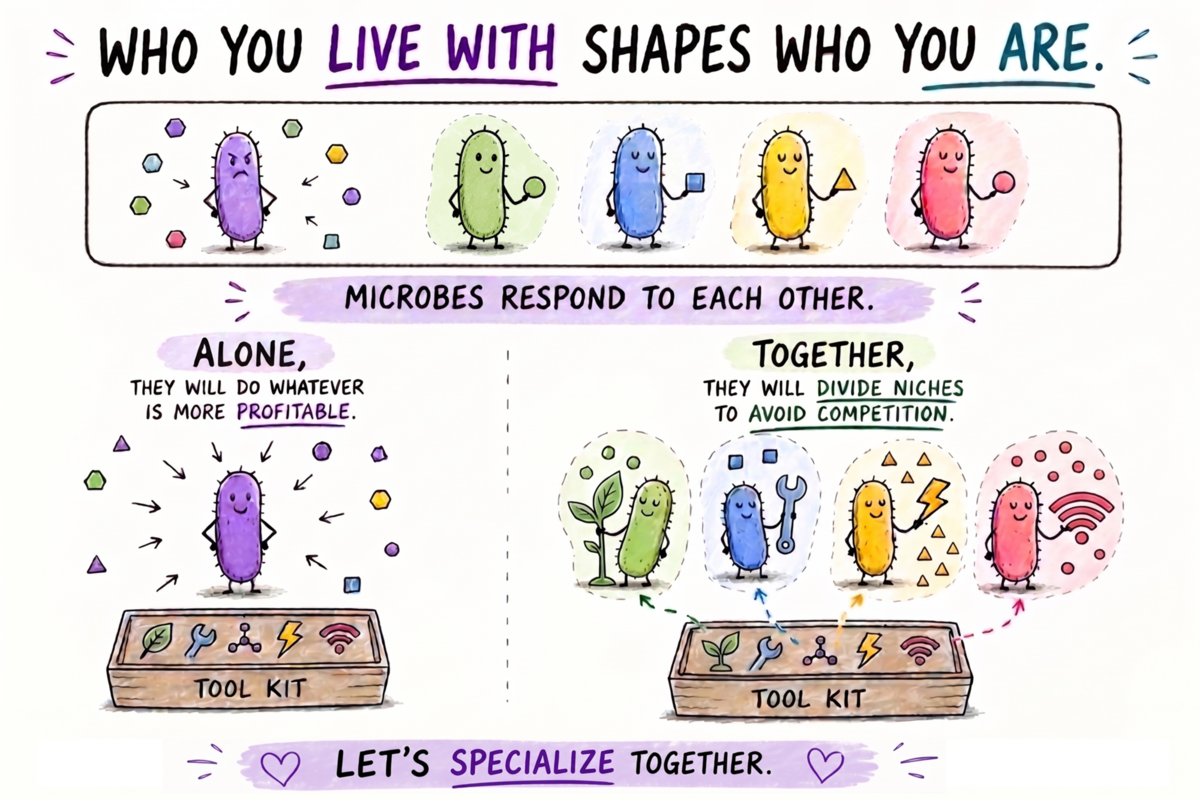
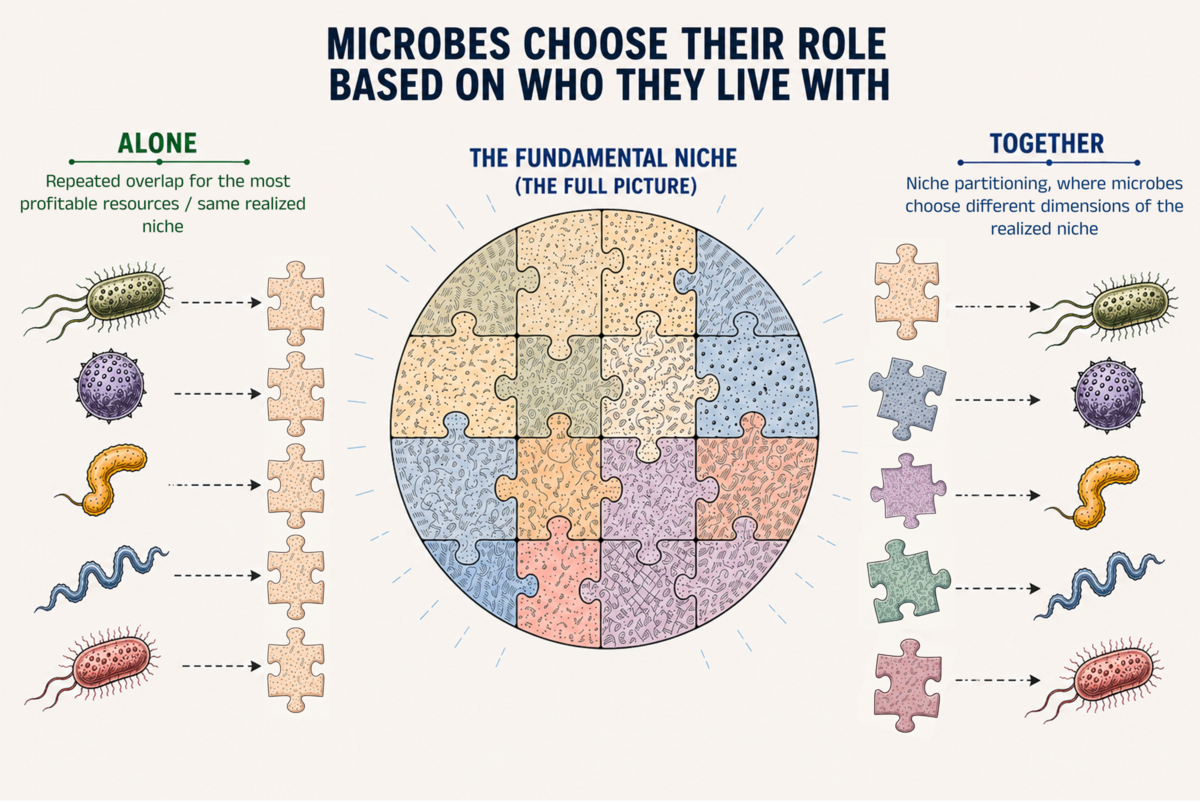
The study focuses on the question as to how microbes reduce competition although many of them appear to use similar resources. Using artificially constructed microbial communities, the researchers were able to systematically track for the first time how individual species alter their proteomes—the totality of all proteins produced—when they grow alone or together with others. A surprisingly clear pattern emerged: as soon as other microbes are present, bacteria significantly alter their protein production in a reproducible manner.
What is particularly noteworthy is that these adaptations are highly specific. Each bacterial species reacts differently to different partners, suggesting that microbes actively “perceive” their environment and respond specifically to certain neighbours. These partner-dependent changes affect not only individual metabolic pathways but extend throughout the entire proteome. This represents a comprehensive, system-wide adaptation.
Specialisation instead of competition
A key finding of the study is that these adaptations lead to a significant reduction in functional overlap. In the vast majority of the examined cases, the researchers observed that microbes reduce functions that could also be performed by other members of the community. At the same time, they maintain vital core processes. This pattern suggests the sharing of tasks: rather than performing every possible function in parallel, individual species specialise and make use of the capabilities of their neighbours.
This functional specialisation also appears to have a positive effect on the community’s performance. The researchers found evidence that microbial consortia with lower functional redundancy often exhibit higher overall productivity. One possible explanation is that microbes conserve energy by refraining from producing unnecessary proteins and instead benefit from the metabolic products of other species.
Individualised niches and further use of the findings
Furthermore, the study provides a mechanistic explanation for a central concept in ecology: the so-called “realised niche,” i.e. the ecological niche that an organism actually occupies. The results show that microbes dynamically adapt to this niche by altering their gene expression—and thus their functional role—depending on the community. Protein profiles thus become a direct molecular reflection of ecological interactions.
Overall, the study suggests that microbial communities are not simply the result of passive competition, but are shaped by active, finely tuned adaptive processes. This regulatory flexibility enables microorganisms to minimise competition, use resources efficiently, and form stable communities. The findings could have far-reaching implications—from better prediction of natural microbiomes to the targeted design of synthetic microbial systems for applications in medicine, agriculture, and environmental engineering.
Further information
Publication: “Community context reshapes microbial proteomes and reduces functional overlap.” Moraïs S, Mazor M, Amit I, Gerth P, Trautwein-Schult A, Maaß S, Grinshpan I, Shelly Y, Levin L, Becher D, Mizrahi I. Nat Microbiol. 2026 Apr 24. doi: 10.1038/s41564-026-02310-w.
Contacts at the University of Greifswald
Prof. Dr. Dörte Becher
Microbial Proteomics
Felix-Hausdorff-Straße 8
17489 Greifswald
Tel.: +49 3834 420 5903
dbecheruni-greifswaldde
Dr. Anke Trautwein-Schult
Microbial Proteomics
Felix-Hausdorff-Straße 8
17489 Greifswald
Tel.: +49 3834 420 5922
anke.trautwein-schultuni-greifswaldde
linkedin.com/in/anke-trautwein-schult-08346864