
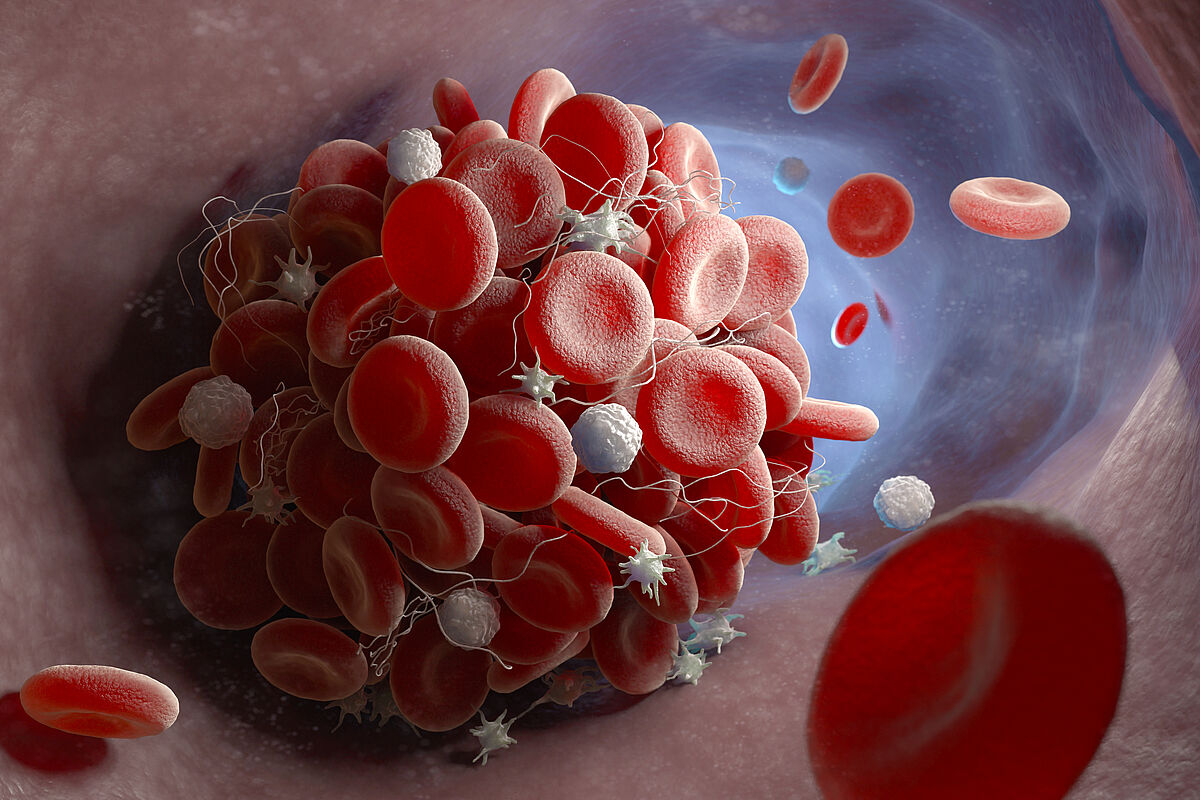

The researchers from Greifswald and the KU Leuven (Belgium) have deciphered in detail for the first time how an important enzyme in human blood – ADAMTS13 – is structurally regulated. This enzyme acts as a kind of “safety mechanism”. It prevents the formation of dangerous blood clots that can block small blood vessels.
A long-standing unsolved mystery
The study provides the most accurate model to date of how ADAMTS13 switches between its inactive and active states. “The field knew ADAMTS13 existed in a closed state,” explains lead author Norman Geist from the University of Greifswald. “But we did not understand the structural logic behind it. These results are very important because they finally provide a clear blueprint for a mystery researchers have been trying to solve for over 20 years.”
A previously underestimated component of the enzyme – a flexible connection region, the so-called “L3 Linker” – is at the centre of the findings. The researchers were able to demonstrate that this region behaves like a built-in safety cap. It blocks critical substrate-binding regions and thus keeps the enzyme inactive until it is actually needed. It functions as a pseudosubstrate, mimicking the actual substrate VWF-A2 by matching the amino acid sequence.
This mechanism can be described as a “molecular zipper”: various parts of the enzyme “zip up” together and stabilise the closed state. If ADAMTS13 is needed, this structure can be reopened quickly.
Simulation vs. experiments
The researchers made this mechanism visible by combining sophisticated computer simulations with experimental laboratory work. The movements of biomolecules were calculated particularly efficiently and precisely using an algorithm developed at the University of Greifswald. The simulations themselves took several years of computation on the high-performance computing infrastructure in Göttingen due to the complexity of the molecular system.
“This work demonstrates how advanced computational modelling and experimental thrombosis research can now be integrated at an unprecedented level,” says Prof. Dr. Mihaela Delcea, Professor of Biophysical Chemistry at the University of Greifswald. The results not only help to improve our understanding of fundamental processes in the human body. In the long term, they could also provide new approaches for treating serious illnesses. These include, for example, the rare, but life-threatening disease thrombotic thrombocytopenic purpura (TTP) which is linked to failure in the regulation of ADAMTS13.
New treatment perspectives
“If we know exactly where the molecular zipper is located, it becomes possible to design much more precise therapies,” says Norman Geist. “In the long term, this could allow for the development of molecules that selectively stabilise or restore the closed state of ADAMTS13 if regulation fails.”
Further information
The study was produced in collaboration between the University of Greifswald and KU Leuven, one of the world’s leading centres for research into thrombosis. The experimental results confirmed the computational models and together, both reconciled numerous, previously contradictory experimental observations.
Publication: Geist, N., Bonnez, Q., Vanhoorelbeke, K., & Delcea, M. (2026). Wrapping It Up: Structural Basis of ADAMTS13 Global Latency. Journal of Thrombosis and Haemostasis. Advance online publication. https://doi.org/10.1016/j.jtha.2026.05.005
Open-Access publication: https://www.sciencedirect.com/science/article/pii/S1538783626003272?via%3Dihub
Contacts at the University of Greifswald
Norman Geist
Biophysical Chemistry
Felix-Hausdorff-Straße 4, 17489 Greifswald
Tel.: +49 3834 420 4409
norman.geistuni-greifswaldde
Norman Geist on LinkedIn
Prof. Dr. Mihaela Delcea
Biophysical Chemistry
Felix Hausdorff-Straße 4, 17489 Greifswald
Tel.: +49 3834 420 4423
delceamuni-greifswaldde
Mihaela Delcea on LinkedIn