
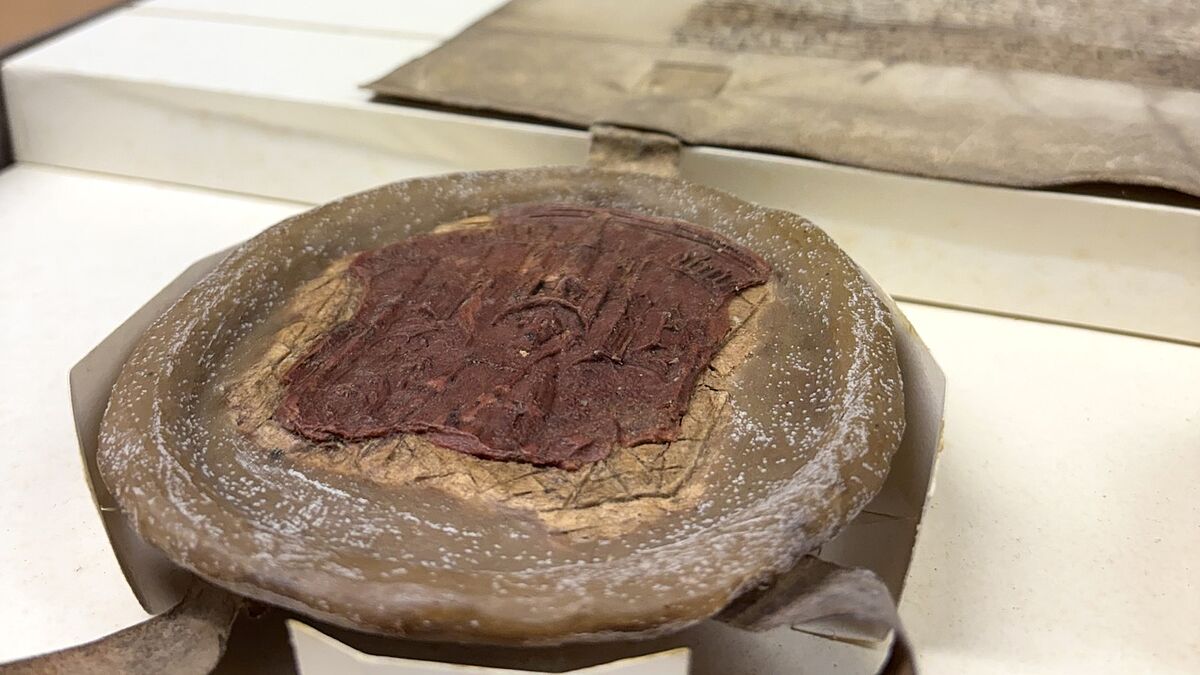
A parchment, three seals and an agreement that was to shape how people lived together in Greifswald: in October 1456, the University, the town council and the cathedral chapter of St. Nicholas sealed their partnership. The University had been ceremoniously opened just four days earlier. But how was this new educational institution supposed to operate? Who was authorised to pass judgement on whom, who bore which costs, and how were disputes to be resolved? The so-called “Eintrachtsurkunde” (Charter of Concord) provided the answers. To this day, it describes how closely the history of the University of Greifswald is tied to the history of the town.
The University owed its foundation largely to Heinrich Rubenow, the Mayor of Greifswald. He campaigned for a university to be established in the town. After Emperor Frederick III and Pope Calixtus III had given their approval, Wartislaw IX, Duke of Pomerania, placed the University under his protection. On 17 October 1456, it was officially opened as the Academia Gryphica. Heinrich Rubenow took up the post of the first Rector.
The foundation ceremony took place at St Nicholas' Cathedral. The University began with the four traditional faculties: Theology, Philosophy, Medicine, and Law. This laid the foundation for an institution that continues to shape Greifswald to this day. However, in the 15th century, a university encompassed more than just teaching: it needed money, rooms and clear rules for co-existing with the town.
What three seals sealed
The Charter of Concord illustrates just how closely the new university was intertwined with Greifswald. The oversized parchment is kept in Greifswald’s University Archive. The seals of the University, the cathedral chapter and the Town are attached to the charter – visible signs that three independent institutions had agreed on a set of common rules.
The charter covered a wide range of matters that may seem unusual at first glance today. Who was authorised to pass judgement on citizens and members of the university community? Who contributed towards the University’s construction costs? How was the income to be managed? And what happened if students got into arguments? The agreement also included details on the University’s purchase of buildings, the serving of beer, and the establishment of a “Karzer”, the University’s own detention cell.
However, this agreement did not mean that all those involved shared the same interests. Instead, it set out who was to assume which rights and obligations. The town council pledged to provide support for the University, whilst also securing its own means of exerting influence. The agreement thus laid the groundwork for cooperation and for dealing with potential conflicts.
A contract with long-term effect
The Charter of Concord was more than just an addendum to the foundation of the University. It marked the culmination of a series of agreements which legally and organisationally established the University in Greifswald. In the 16th century, it was often referred to as the ‘Old Union’. It remained significant even later on: following the Reformation, and again in the mid-17th century, it served as the framework for negotiations between the University and the town.
The agreement also stipulated where important documents and the University’s funds were to be kept: in a cupboard in St Nicholas, the three keys to which were held by the Rector, the Provost, and the eldest mayor. The cupboard is located in what is now the Mayor’s Chapel, where it has been preserved to this day. You can even still make out the holes for the original locking mechanism. Until the first central university building was opened in 1591, the University’s documents and funds were kept here.
The cathedral and the University – a link that spans centuries
The close relationship between St. Nicholas and the University was also evident in everyday academic life. For centuries, doctoral degree ceremonies were held in the cathedral. The canons were also professors, and the General Superintendent also held the office of Prokanzler (Pro-Chancellor) of the University. Houses were built for professors around the church; these were used both as homes and for teaching.
This combination is still visible today. For example, the cathedral is home to the Rubenow Plaque, donated by Heinrich Rubenow. And students, lecturers and guests still gather here, for example at the annual opening ceremony. The 300th, 400th, and 500th anniversaries of the University were also celebrated at St. Nicholas.
570 years after its foundation, the history of the University of Greifswald is therefore not just a story of scholarship and teaching. It also recounts negotiations, shared rules and the interplay of various interests. The Charter of Concord makes it clear: the University did not emerge in a vacuum, but as an integral part of a town whose history it continues to help shape to this day.
Further information
More on the University’s history: Alvermann, Dirk / Spieß, Karl-Heinz (eds.): Quellen zur Verfassungsgeschichte der Universität Greifswald. Vol. 1: Von der Universitätsgründung bis zum Westfälischen Frieden 1456–1648. Beiträge zur Geschichte der Universität Greifswald, Vol. 10.1. Stuttgart: Franz Steiner Publishing House, 2011. ISBN 978-3515096553
Contacts at the University of Greifswald
University Communications
Domstraße 11, Entrance 2, 17489 Greifswald
Tel.: +49 3834 420 1150
pressestelleuni-greifswaldde
Dr. Elisabeth Heigl
Head of the University Archives
Baderstraße 4/5, 17489 Greifswald
Tel.: +49 3834 420 1155
archivuni-greifswaldde