
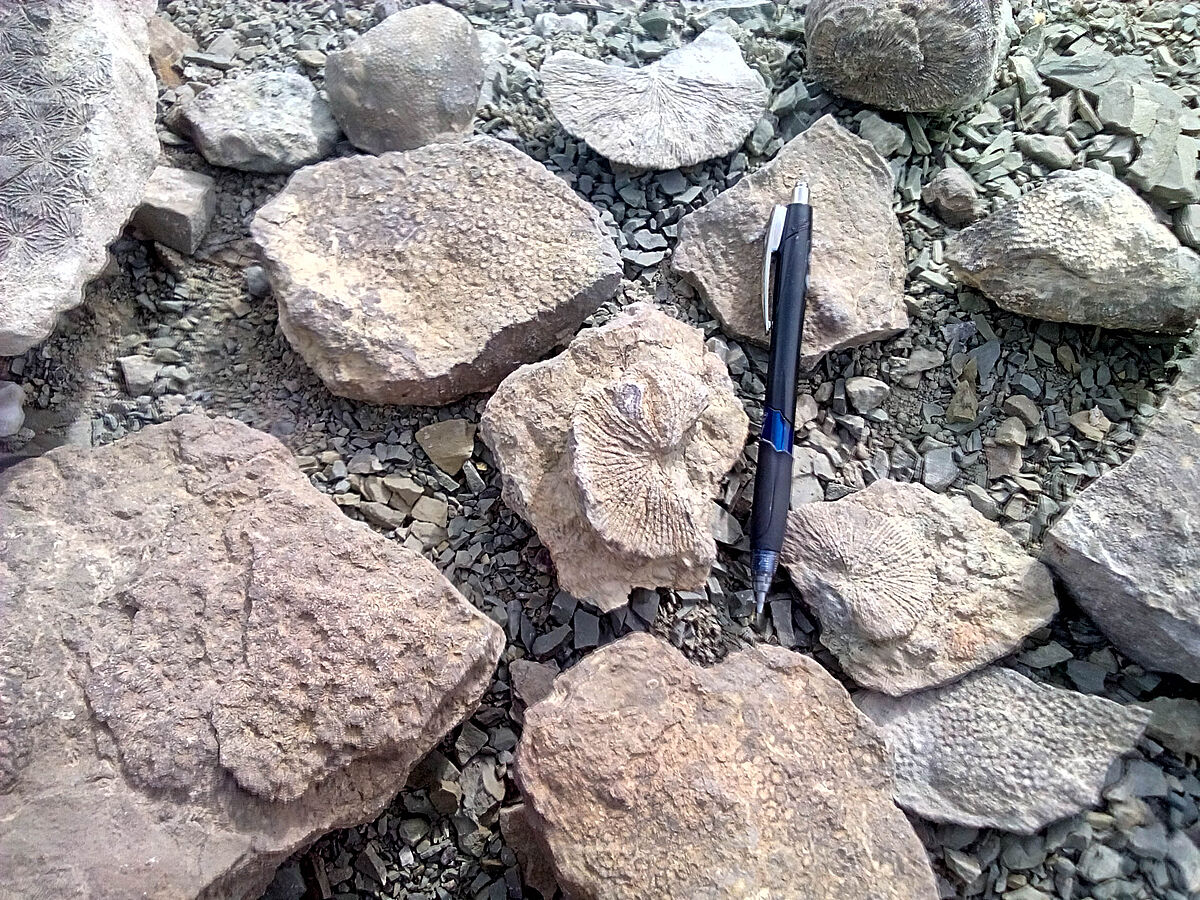
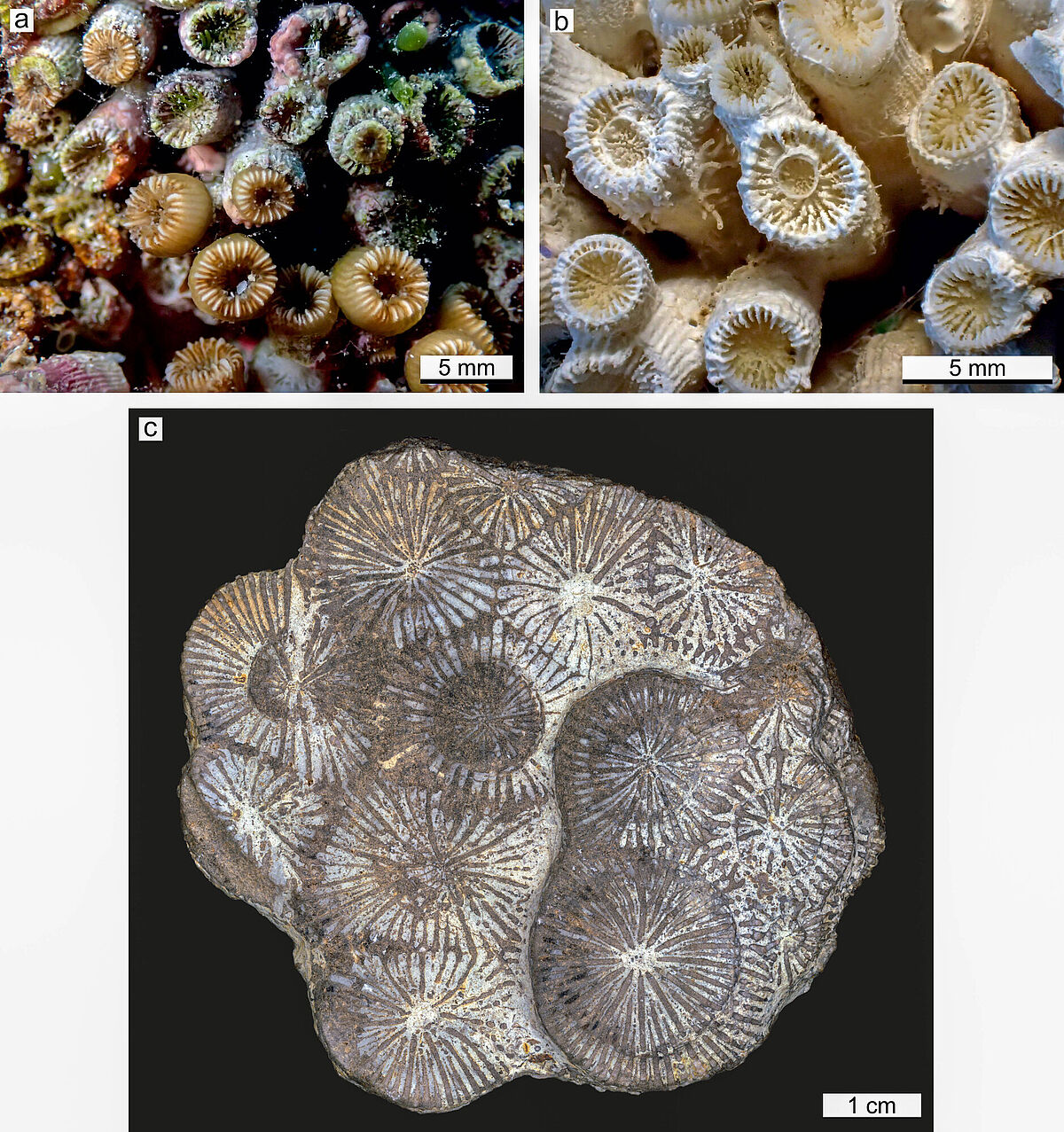
The studied coral lived in the northern Indian Ocean around 16 to 17 million years ago, during the Miocene Climatic Optimum, a long-lasting warm phase when average global temperatures were approximately 3 to 4°C higher than today. The fossil from Iran documents a partial colony mortality followed by regeneration: while parts of the colony died, the surviving polyps contracted and formed new, smaller corallites – the skeletal cups of individual polyps – within the existing skeletal framework. The previously dead areas of the colony could then regenerate from these newly formed structures.
In living corals, the polyps shrink and reduce their metabolic activity, allowing them to survive periods of heat-related food limitation. When environmental conditions improve, they can return to their original size and reproduce asexually, thereby contributing to the recovery of damaged parts of the colony.
“I am particularly surprised that we observe an almost identical morphological response in corals separated by millions of years and originating from completely different regions,” says Markus Reuter. This similarity raises the question of whether we are seeing a very old mechanism deeply rooted in coral biology, or whether a similar response has evolved independently on multiple occasions.
A look back at past warm periods with implications for the future
Coral reefs are sensitive to rising sea surface temperatures and are increasingly affected by marine heat waves. At the same time, geological evidence shows that coral reefs have survived past phases of global warmth. However, it is almost impossible to reconstruct from the fossil record how individual corals coped with the associated environmental stresses.
“Our study provides a rare insight into how corals may have responded to thermal stress during a globally warm period in Earth’s history,” explains Reuter. The study helps us better understand the strategies corals have developed over the course of their evolutionary history to cope with challenging environmental conditions – and where their limits lie.
New perspectives for climate research
The discovery is no reason to sound the all-clear for the future of coral reefs. However, the link between rejuvenescence and severe thermal stress makes the phenomenon particularly interesting for climate research. The response may occur when individual coral species or colonies are already approaching their thermal tolerance limit.
“Rejuvenescence should therefore not be understood as evidence that coral reefs can survive climate change without difficulty,” says Reuter. Instead, this rare and easily overlooked phenomenon could serve as a morphological warning sign of critical heat stress. It is important to distinguish between the resilience of individual corals and the stability of the reef ecosystem as a whole.
Warning signals that are millions of years old
This finding also opens up another perspective: rejuvenescence might not only help us better assess the impacts of climate change on reef corals, but also reconstruct past climate extremes.
However, it is still unclear exactly what triggers rejuvenescence and whether high temperatures alone are responsible. Further long-term observations of living corals under different environmental conditions could shed light on this question. Investigating additional fossil coral reefs could also reveal how far back in Earth’s history this response can be traced and in what climatic contexts it occurred.
Further information
In addition to the University of Greifswald, the study involved researchers from the University of Graz, the Natural History Museum Vienna, the University of Modena and Reggio Emilia, Sapienza University of Rome, the Geological Survey of Iran, and the Torre de la Sal Aquaculture Institute of the Spanish National Research Council (CSIC).
Publication: Reuter, M., Piller, W.E., Harzhauser, M., et al. Rejuvenescence suggests recurrent coral responses in Miocene and modern reefs near upper thermal tolerance limits. npj iodivers 5, 26 (2026). https://doi.org/10.1038/s44185-026-00152-7
Contact at the University of Greifswald
PD Dr. Markus Reuter
Institute of Geography and Geology
Friedrich-Ludwig-Jahn-Straße 17A, 17489 Greifswald
Tel: +49 3834 420 4586
markus.reuteruni-greifswaldde