

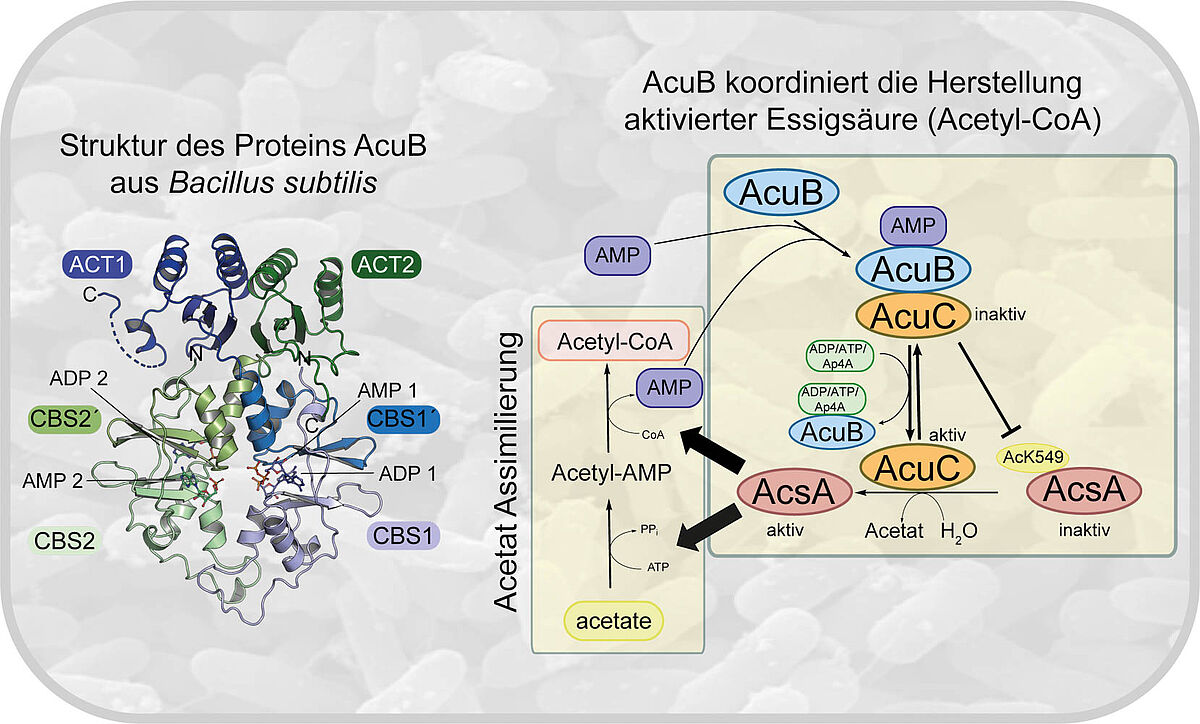
When cells are supplied with an abundance of nutrients, they are forced to decide whether to gain energy or create building blocks for growth. At the heart of this decision-making process is acetyl coenzyme A, which links the decomposition of nutrients with the synthesis of proteins, carbohydrates and lipids, thereby acting as a central hub for the entire metabolism during cell formation. As part of a project funded by the German Research Foundation (DFG), a Greifswald research team led by Prof. Dr. Michael Lammers from the Institute of Biochemistry has now succeeded in uncovering a previously unknown regulatory mechanism for the production of this important molecule in bacteria such as Bacillus subtilis. In these bacteria, acetyl-CoA is produced from acetic acid, the universal cellular energy source adenosine triphosphate (ATP) and the molecule coenzyme A, which is important for increasing the biochemical reactivity of acetic acid. This reaction is catalysed in cells by a biocatalyst, the enzyme acetyl-CoA synthetase (AcsA). The activity of this enzyme can be switched on or off like a light switch by attaching and removing a small biochemical modification, the acetylation of the amino acid lysine. As a consequence, the presence of this modification is decisive for whether acetyl-CoA is formed or not: if the modification is present, the enzyme AcsA is inactive; if it is not present, it is active.
A protein as a sensor: AcuB and the cell's energy supply
The research team, led by Lammers and the doctoral candidate and first author of the study, PhD student Markus Janetzky (M.Sc. Biochemistry), was able to precisely elucidate the exact structure and function of the AcuB protein at molecular level. AcuB is a protein that acts as a sensor of the current energy state in cells and coordinates the production of activated acetic acid. It can bind directly to the enzyme AcuC and inhibit its catalytic activity. Biochemically speaking, AcuC is a so-called deacetylase, which can remove the modification from the biocatalyst AcsA and thus activate it for the production of acetyl-CoA. The study shows that the energy state of the cell is crucial in this process. AcuB only inhibits AcuC when it has bound adenosine monophosphate (AMP). Unlike ATP, AMP is an indicator of low energy levels in cells. This ensures that the cell only produces acetyl-CoA when it has enough energy to carry out vital processes such as growth or repair.
Other research groups from the Faculty of Mathematics and Natural Sciences at the University of Greifswald were also involved in the study. Molecular dynamics (MD) simulations carried out by Norman Geist from Prof. Dr. Mihaela Delcea's research group at the Institute of Biochemistry played an important role. “Our results show how important the dynamics of changes in protein shape are for their function,” explains Lammers. “By binding different adenine nucleotides, AcuB acts like a sensor of cellular energy status – it indirectly adapts the activity of the enzyme used to produce acetyl coenzyme A to the metabolic state of the cell. This is a previously unknown regulatory mechanism that expands our understanding of metabolic coordination in bacteria.”
New mechanism with further implications
Starting with the research work of microbiologist Prof. Dr. Michael Hecker, Bacillus subtilis and its metabolism has been the focus of research at the University of Greifswald for many years. The new findings not only provide insights into the coordination of acetyl-CoA production, they also open up new research paths in a class of enzymes in bacteria that has been only partially understood until now: lysine deacetylases. “Our data supports the notion that regulation of the activity of these enzymes plays an important role in controlling protein functions and adapting to the metabolic state in bacteria,” says Janetzky. “This provides new insights into fundamental regulatory mechanisms of cellular processes. Our results show how dynamically bacterial systems respond to changes in their surroundings and adapt their metabolism accordingly. This broadens our understanding of molecular adaptation strategies.”
Further information
Janetzky, M., Geist, N., Schulze, S. et al. AcuB senses cellular energy charge to coordinate acetyl-CoA synthesis in bacteria. Nat Commun 17, 3815 (2026). https://doi.org/10.1038/s41467-026-71006-w
Contact at the University of Greifswald
Prof. Michael Lammers
Institute of Biochemistry, Synthetic and Structural Biochemistry
Felix-Hausdorff-Straße 4, 17489 Greifswald
Tel: +49 3834 420 4365
michael.lammersuni-greifswaldde