
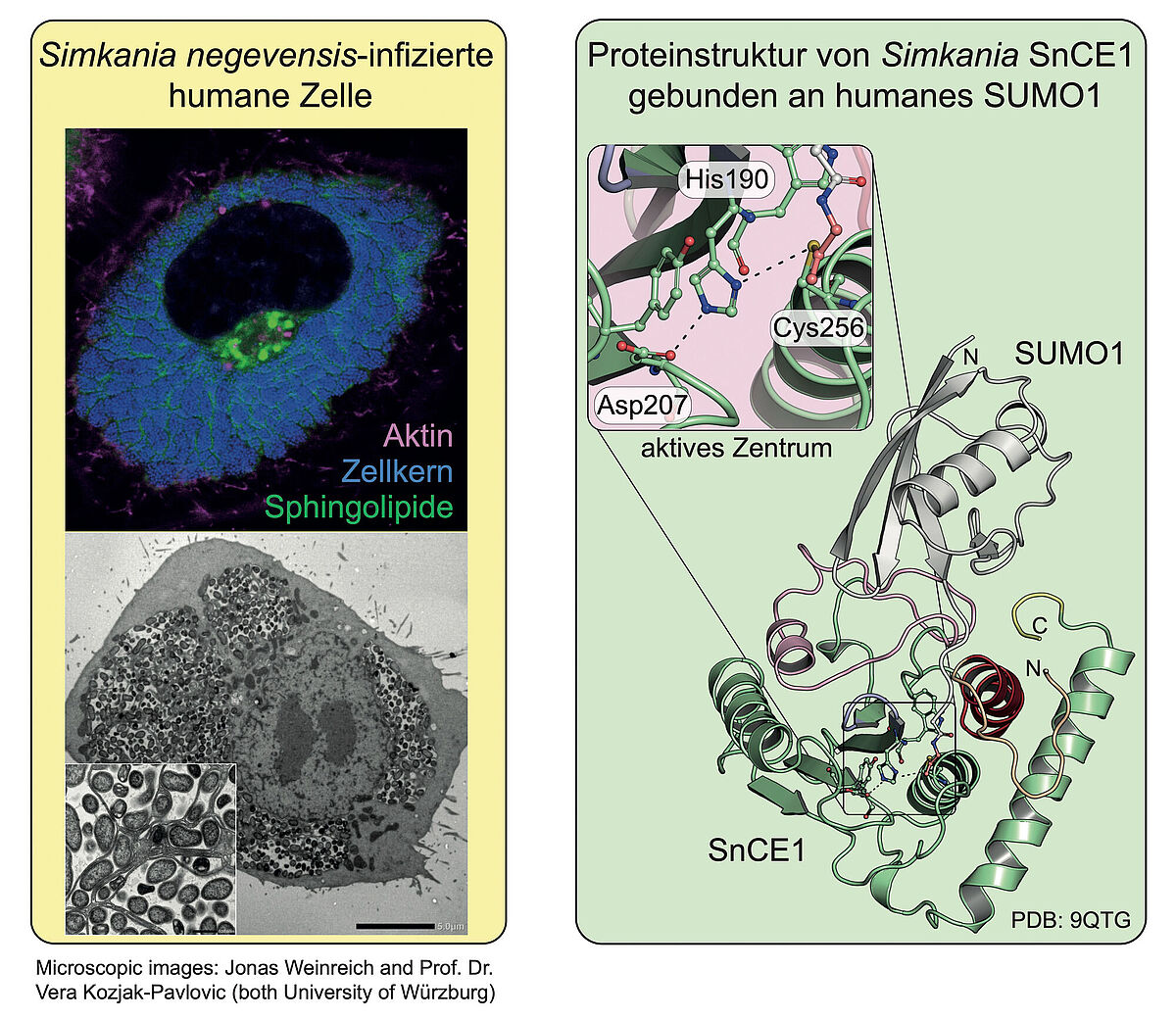

Bacterial pathogens can infect various kinds of human cells and trigger serious illnesses. At the same time, the increasing spread of antimicrobial-resistant bacteria is posing significant challenges to hospitals and healthcare systems across the globe. A research team led by Prof. Dr. Michael Lammers and lead author Ole Schmöker investigated the virulence factor SnCE1 of the Chlamydia-like bacterial pathogen Simkania negevensis. This bacterium can cause illnesses such as respiratory or pulmonary infections. Virulence factors are specialised proteins with which bacteria specifically influence human cells. The pathogens use special transport systems to smuggle these proteins into the host cells. Once there, they modify the cells to facilitate the bacteria’s reproduction, making it easier for infections to spread.
SnCE1 reacts to the cell’s metabolic state
The research team was able to demonstrate for the first time that the activity of the bacterial protein SnCE1 is directly dependent on the metabolic state of the host cell. The molecule Acetyl-CoA, which plays an important role in providing energy to the cell, is the decisive factor. The greater the amount of Acetyl-CoA, the greater the changes to the structure and function of the protein. SnCE1 can perform two tasks at the same time: firstly, it removes SUMO molecules from proteins in the host cell and thus intervenes with important regulation mechanisms. Secondly, it can chemically modify itself by attaching acetyl groups to certain amino acids (lysines). Surprisingly, both reactions are catalysed by the same active site of the enzyme. This mechanism was previously unknown and shows just how closely the activity of SnCE1 is linked to the metabolic state of the host cell.
Particularly significant: the self-modification determines whether SnCE1 remains active on its own. This is how the bacteria directly adjust their pathogenic effect to the metabolic state of the host cell. The researchers also discovered that enzymes in the host cell influence the bacterial protein by modulating its acetylation state. In turn, this not only changes its activity, but also its location in the cell. In this way, SnCE1 sometimes migrates to the mitochondria, the cell’s powerhouses. When there, the protein initiates the division – a so-called fragmentation – of the mitochondria. How this exactly happens remains unclear.
Interdisciplinary collaboration for a deeper understanding of infections
The study is the result of close collaboration between research groups at the Faculty of Mathematics and Natural Sciences and University Medicine Greifswald, as well as external partners at the Universities of Würzburg and Cologne. The interdisciplinary collaboration was a key factor to the success of the study and is a good example of how strong networking advances modern research.
The discovery could have long-term implications for medicine. Hospitals are increasingly finding that they are no longer able to count on standard antibiotics for certain illnesses. Patients require longer treatment, in some cases doctors change the medication several times. The Greifswald study now describes a mechanism that has received only little attention in the past: Bacteria adjust their activity to the metabolic state of human cells, thereby regulating their reproduction in the body.
“Our results show how important the chemical modification of proteins is for adjusting the bacterial virulence factors to the host cell’s metabolism,” explains lead author Ole Smöker. Lammers adds: “SnCE1 can perform various enzymatic reactions catalysed by the same active site. This enables the protein to get involved directly in cellular processes and adjust its activity according to the condition of the host cell at the same time. A better understanding of such mechanisms should help us to decipher basic strategies of bacterial infections. In the long term, these findings could contribute to the discovery of new treatment approaches for bacterial pathogens and antimicrobial-resistant bacteria.”
Further information:
The Research Training Group RTG-PRO, a training and research programme for doctoral candidates funded by the German Research Council (DFG), led by spokeswoman Prof. Dr. Barbara Bröker, unites a number of research groups at the University of Greifswald. Doctoral candidates belong to e.g. the Faculty of Mathematics and Natural Sciences, University Medicine Greifswald, and the Friedrich-Loeffler-Institut (FLI). The Group aims to improve our understanding of enzymes that break down proteins (proteases) in infection and inflammation processes.
Important contributions to the study — including cell biology experiments, mass spectrometry analyses, computer-aided structure prediction, and bioinformatics evaluations — were made by the teams led by Prof. Elke Krüger (University Medicine Greifswald), Prof. Vera Kozjak-Pavlovic (University of Würzburg), Prof. Marcus Krüger and Prof. Kay Hofmann (University of Cologne), Prof. Uwe Völker and Prof. Uwe Bornscheuer (University of Greifswald), and the University of Greifswald’s Computer Centre (URZ).
Publication:
Schmöker, O., Girbardt, B., Schulze, S., et al. Reprogramming of bacterial virulence through lysine acetylation. Nat Commun 17, 3859 (2026). https://doi.org/10.1038/s41467-026-72244-8
Contact at the University of Greifswald
Prof. Michael Lammers
Institute of Biochemistry
Synthetic and Structural Biochemistry
Felix-Hausdorff-Straße 4, 17489 Greifswald
Tel: +49 3834 420 4365
michael.lammersuni-greifswaldde
RTG2719 PRO on LinkedIn: https://www.linkedin.com/in/rtg2719-pro/
Ole Schmöker on LinkedIn: https://www.linkedin.com/in/oleschmoeker/