
In wealthy industrial countries, health economics often concentrates on the optimisation of processes that already work. By contrast, low-income countries have to focus on existential issues. The majority of the world’s population lives in regions in which there is a serious lack of medical resources. In such contexts, economic efficiency turns into ethical responsibility as it determines access to the provision of vital care.
Efficiency as an ethical obligation
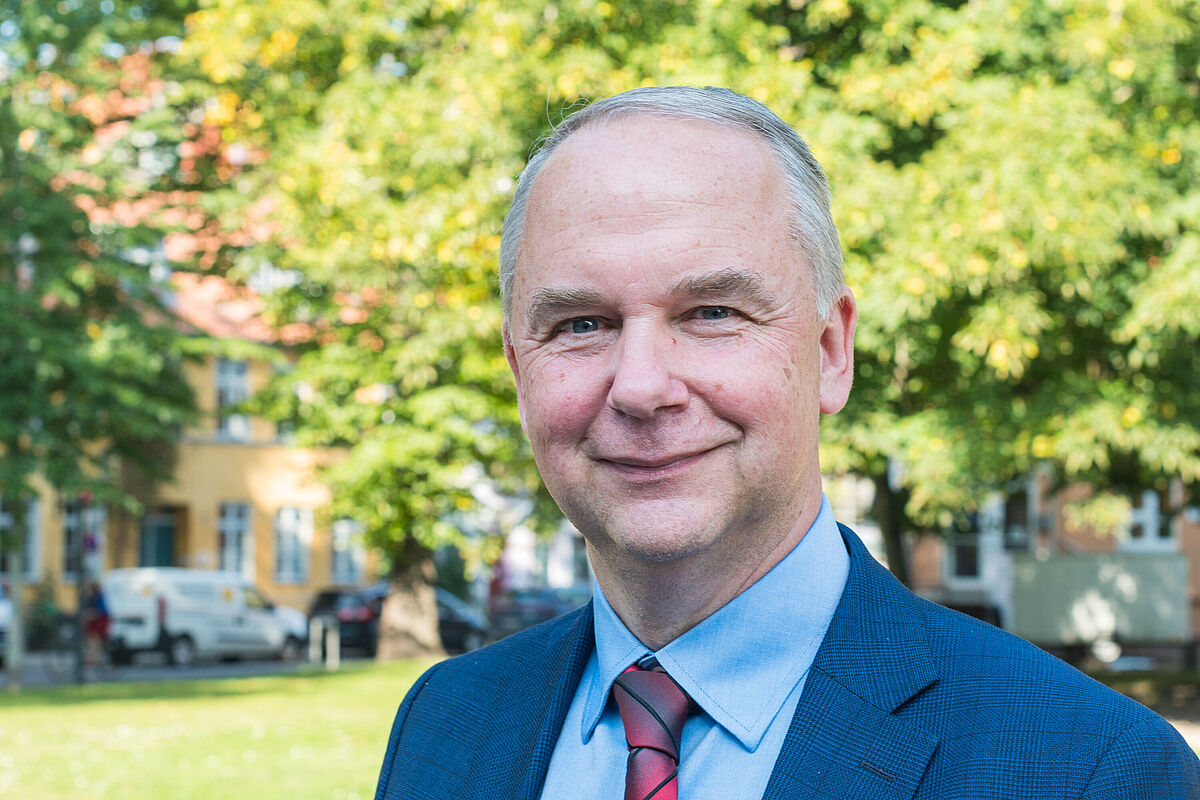
“Where resources are scarce, the way they are used often makes the difference between life and death,” says Steffen Fleßa, Professor of General Business Administration and Healthcare Management at the University of Greifswald. “Resources that are used inefficiently, i.e. wasted, are no longer available for looking after patients further down the line. Efficiency is therefore much more than an economic principle – it is an ethical obligation, particularly in those countries with extremely limited financial means. This is exactly where international healthcare management comes into play: it concentrates on improving structures and processes to enable as many people as possible to receive effective and equal treatment with the available resources.”
Based on this conviction, Fleßa does not consider international healthcare management to be an administration task, it is rather the imparting of knowledge with the aim of improving the entire population’s health by increasing the efficiency of the system. Using efficiency to improve equity is particularly important to him: freeing up resources to reduce mortality and improve the quality of life for billions of people.
A holistic approach based on 35 years of professional experience
Addressing these complex challenges from a purely business management perspective does not go far enough. Based on more than 35 years of international professional experience – in countries such as Tanzania, Cambodia, Vietnam, Venezuela, and Uzbekistan – Fleßa adopts an interdisciplinary approach. By linking economic principles with findings from the fields of epidemiology, geography, and ethnology, as well as other disciplines, he produces an interdisciplinary perspective that goes beyond typical management approaches. This is the only way to paint the full picture of the healthcare systems that actually reflects local obstacles.
“Every wasted resource is missing in circumstances where it could save lives,” is how Fleßa describes his motivation. “The aim of the book is to provide experts and managerial staff with specific instruments for improving the analysis, evaluation and design of the healthcare systems – for example by analysing the supply and demand or designing more efficient financial models. The book’s central proposition will always remain relevant: efficiency does not just make sense from an economic perspective; it can actually save lives.”
Further information
Publication: Fleßa, Steffen. International Health Care Management Towards Efficiency, Effectiveness and Equity of Healthcare Systems in Low- and Middle-Income Countries, De Gruyter, 2026. https://doi.org/10.1515/9783112217290
Prof. Dr. Steffen Fleßa is Professor of General Business Administration and Health Management and, since April 2026, Dean of the Faculty of Law and Economics at the University of Greifswald. With his many years of experience in research and practice – including in Tanzania, Kenya, Vietnam, Cambodia, and Uzbekistan – he has become an expert in the managements of healthcare in peripheral regions, as well as low and lower-middle-income countries.
Contact at the University of Greifswald
Prof. Dr. Steffen Fleßa
General Business Administration and Healthcare Management
Friedrich-Loeffler-Straße 70, 17489 Greifswald
Tel.: +49 3834 3834 420 2476
steffen.flessauni-greifswaldde