
Climate Protection Strategy
The five working groups covering the sectors “Energy, Campus & Buildings,” “University-Owned Property,” “Mobility,” “Purchasing & Procurement", and “Steering” are a central element of the Climate Protection Strategy. Where possible, the working groups are composed of members from all university member groups and meet approximately twice a year to prepare and implement climate protection measures, and to help with greenhouse gas monitoring. Progress in climate protection is documented in regularly published Climate Protection Reports.
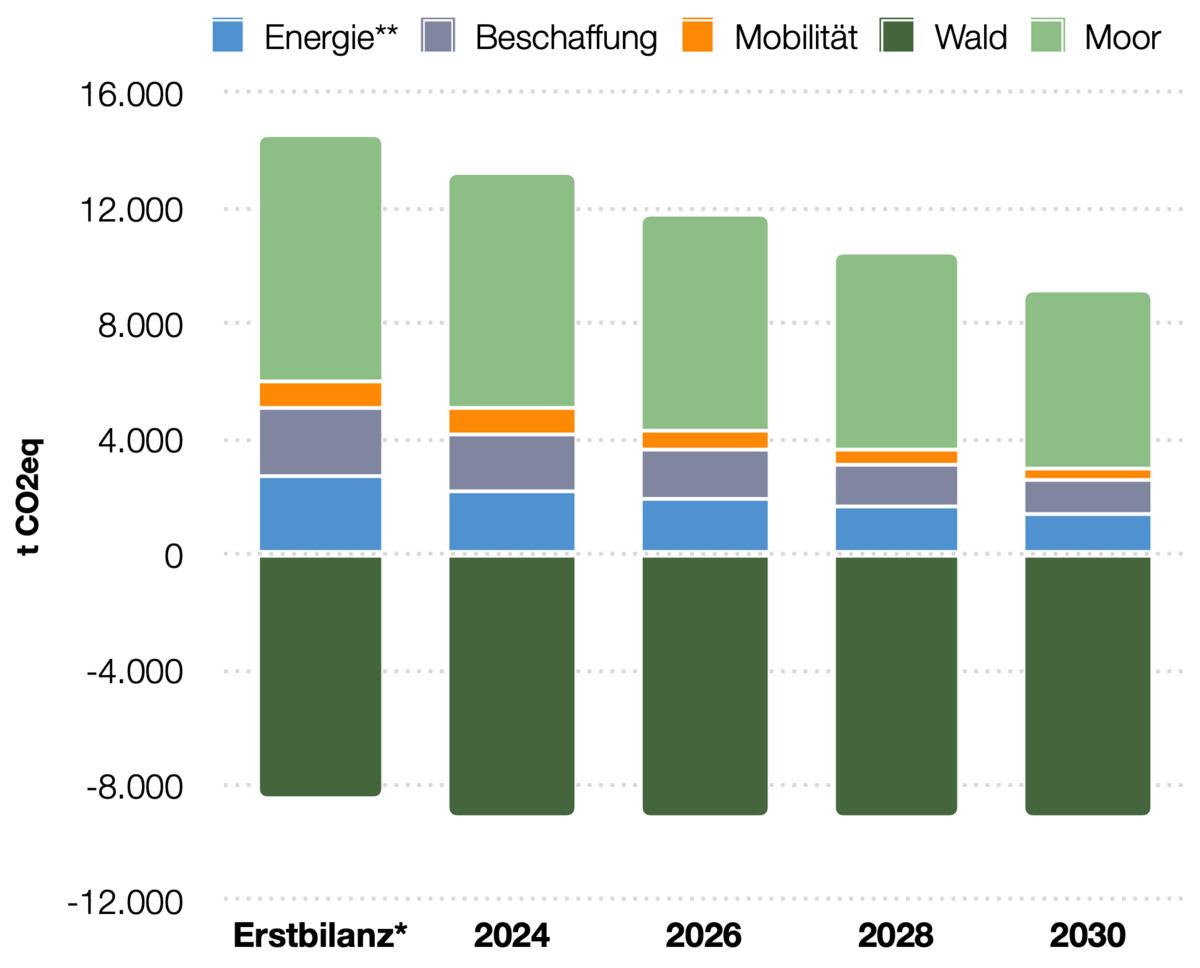
In early 2023, the first Climate Protection Report set the greenhouse gas (GHG) footprint for the reporting year 2021 (base year) as a “benchmark”: it amounts to 6,098 metric tons of CO2 equivalents (t CO2eq). In July 2024, the Academic Senate adopted specific interim targets for reducing GHGs across all areas and sectors (Energy, Mobility, University-Owned Property, and Purchasing) The basic idea is that all sectors will halve their GHG emissions by 2030, and the remaining portion (50% = 3,049 t CO2eq) will be offset by adjustments to the management of the university-owned property, in particular by reducing GHG emissions from the peatlands and increasing the carbon sequestration capacity of the forests.
The university's greenhouse gas accounting
The University has been accounting its greenhouse gas emissions since 2021 with the goal of quantifying as accurately as possible the climate-damaging emissions resulting from its diverse activities. The University’s goal of becoming climate-neutral by 2030 means, in concrete terms, that the university’s greenhouse gas emissions will be minimised or offset to such an extent that, overall, there will be no further direct or indirect greenhouse gas emissions from 2030 onwards (net greenhouse gas neutrality). Knowledge of the sources of greenhouse gas emissions and the quantities emitted in each case is, on the one hand, necessary for planning and implementing effective and targeted climate protection measures. On the other hand, it enables monitoring on the path to climate neutrality by showing whether, and to what extent, the set interim targets have been achieved or not.
Therefore, greenhouse gas accounting since 2021 has reflected, as accurately as possible, all greenhouse gas emissions caused by the University’s wide range of activities and its day-to-day operations. This also includes emissions from upstream supply chains and waste disposal. The University of Greifswald adheres to the standards of the Greenhouse Gas Protocol and the ensuing ISO 14064-1 standard. The “system description” explains which emissions are included and which are not – in other words, where the limitations of the GHG accounting lie.
What is included in greenhouse gas accounting?
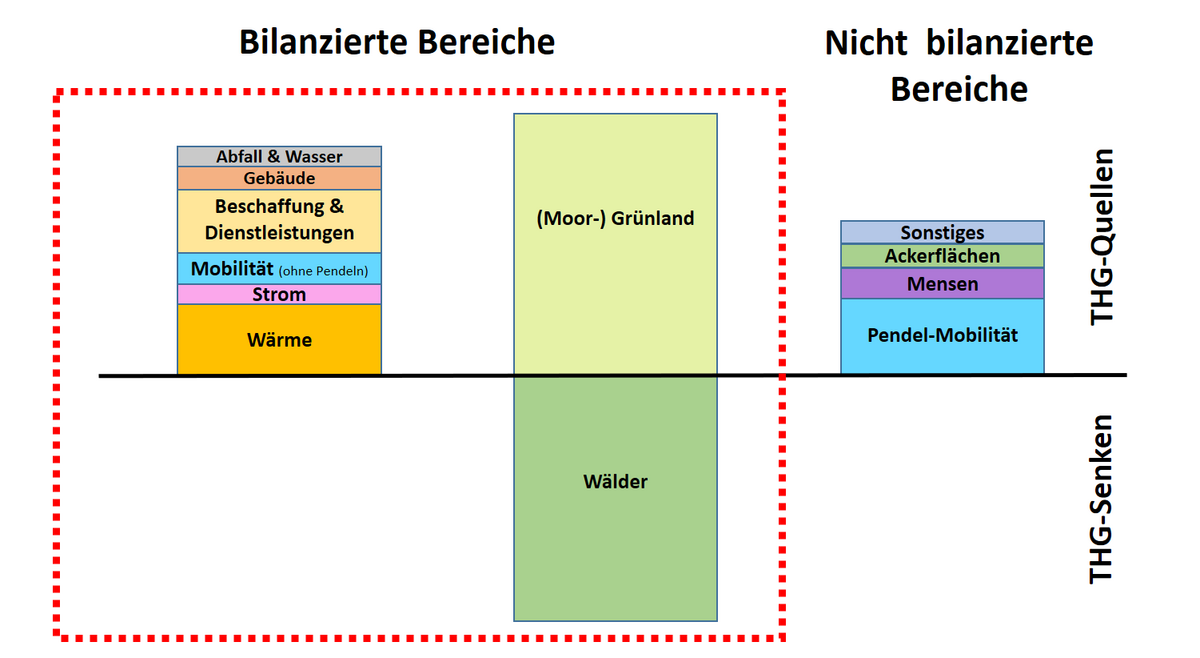
The system boundaries: The University's greenhouse gas accounting generally includes all sites, areas, and organisational units over which the university exercises financial control or whose operational processes it controls. Consequently, the activities of the Student Services (i.e. the Mensa and cafeterias), and University Medicine are not included in the accounting. Similarly, capital investments and the individual commuting journeys of staff and students are not included (the so-called “workplace principle”).
The accounting boundaries: When it comes to accounting, the sources of emissions that are primarily responsible for the university’s greenhouse gas footprint are of particular significance. The significance of these sources is determined above all by the sheer volume of emissions they generate, the extent to which the University can influence them, the availability of existing data, and, finally, their relevance to the university’s stakeholders.
Emission factors
The emission factors used are of central importance for the preparation of the greenhouse gas accounting. The current accounting uses emission factors published by the German Environmental Agency or in the Probas Database. For certain sectors, however, more precise, local emission values were used instead, where reliable sources were available (such as for the district heating supply provided by Stadtwerke Greifswald) or where no suitable emission factors were available in the sources mentioned.
When accounting for greenhouse gas emissions, priority was given to using the emission factors that best reflect actual conditions, i.e. those tailored as specifically as possible to the object being assessed. Emission factors are generally updated at regular intervals to reflect efficiency gains resulting from technological progress or changes in supply chains. Attention was also paid to ensuring that the selected emission factors allow for a certain degree of comparability between the greenhouse gas accounting of the higher education institutions in Mecklenburg-Vorpommern; in cases of doubt, priority was given to accuracy.
5963
t CO2 equivalents
is the result of the calculations to determine the University of Greifswald’s current net greenhouse gas emissions