
FAQs - General Information from the Central Examination Office
on topics such as responsibilities, information, data protection, leave of absence, pregnancy, etc.
The following information is of a general nature and does not replace students' obligations to cooperate, such as reading the relevant examination and study regulations.
What is the Central Examination Office responsible for?
The Central Examination Office is responsible for the organisation/administration of examination procedures and supports the respective examination boards in their tasks. It has a comprehensive right to information in all examination matters vis-à-vis the examiners and the respective examination board. This also applies to examinations for the state examinations in teaching and law degree courses.
How and where can I obtain legally binding information on examination matters?
You can obtain legally binding information on request (by telephone, email or in person) from the Central Examination Office.
Which laws and regulations govern the course of my degree course?
Firstly, the Rahmenprüfungsordnung (General Examination Regulations) [de] regulates the general course of the degree course. It applies to all degree courses at the University of Greifswald; individual regulations for the respective degree course can also be found in the subject-specific examination and study regulations. The subject-specific examination and study regulations have been issued on the basis of the General Examination Regulations since 2012.
When can I reach someone at the Central Examination Office?
You can reach the staff at the Central Examination Office by stopping by in person during consultation hours. However, telephone availability is limited during consultation hours, so we ask for your understanding. Individual appointments outside of consultation hours are possible. Please contact the responsible member of staff over the phone or via email.
Are members of staff present at the Central Examination Office outside consultation hours / during the lecture-free period?
Individual appointments outside of the consultation hours are possible during the lecture period as well as during the lecture-free period. Please contact the responsible member of staff over the phone or via email.
How do I receive information from the Central Examination Office?
You will receive information from the Central Examination Office in person, over the phone, via email or by post. Please also check your university email account regularly and make sure that you can be contacted by post at all times, as notifications will only be sent by post (to the address you have provided).
Do I have to submit applications/documents in person and in an original copy and do I have to pick up confirmations of admission, certificates etc. in person?
Applications or documents can also be scanned and sent to the Central Examination Office via email, provided they bear a handwritten signature. If confirmations of admission, certificates etc. cannot be collected in person, it is possible to authorise someone to collect them for you. Certificates and related documents, on the other hand, are sent automatically after confirmation of the address.
Where can I find the deadline post box?
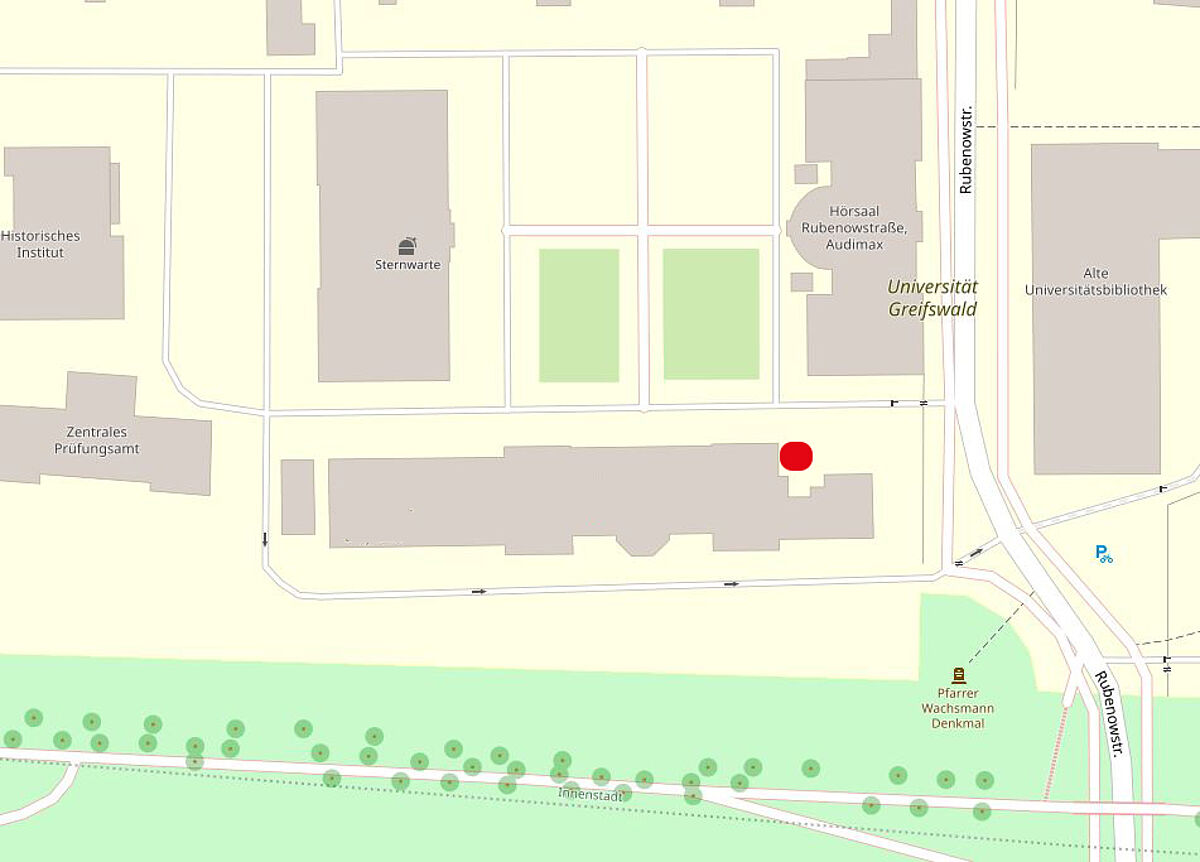
The deadline post box is located at Rubenowstraße 2, next door to the Postal Service. Walk past the Audimax (to your right) on Rubenowstraße and enter the University Courtyard on the right and you will find the red deadline post box about 10 metres behind the barrier on the left-hand side.
Will information be passed on to third parties, e.g. the BAföG Office or my parents?
For data protection reasons, no information will be passed on to third parties (e.g. relatives, authorities, offices, etc.) unless this is required by law (see Hochschulstatistikgesetz (University Statistics Act) etc.). This generally requires the consent of the individual.
What is an application in no specific form? Is there a form for this?
An application in no specific form is a letter that follows no specific rules regarding its formatting. It must contain the personal data required by the authority (e.g. name and student ID number). The place and date, the address of the recipient and a subject line are essential. There should always be a handwritten signature at the end. A reference to any attachments is useful.
There are therefore no forms for this.
What does "immediately" [de: unverzüglich] mean?
Examination and study regulations often require someone to do something immediately. This term is defined in Section 121 of the German Civil Code (BGB) as meaning acting "without culpable delay". This does not necessarily mean that action must be taken immediately. Rather, the person concerned has a period of consideration, the length of which depends on the difficulty of the decision to be made. This therefore depends on the individual circumstances.
How will I be informed whether my request has been granted?
You will be informed of the approval or rejection of a request per notification. This will be sent by post to the address you provided in the self-service portal.
What does "hearing" [de: Anhörung] mean?
A hearing is a legal procedure in which the authority (e.g. the Central Examination Office) gives the person concerned the opportunity to comment on the facts and possible outcome within a reasonable period of time before issuing a decision and/or to submit evidence that is currently not available to the authority.
Is attendance compulsory in classes?
Compulsory attendance in accordance with Section 17a of the General Examination Regulations only applies if this is required in accordance with the subject examination regulations. It may be required for seminars, tutorials, colloquia, language classes, internships, and excursions.
I am expecting a child. What do I need to consider?
Since 1 January 2018, the Mutterschutzgesetz - MuSchG (Maternity Protection Act) has also applied to female students. You should therefore first inform the Students' Registration Office of your pregnancy. The protection periods will then be calculated and communicated to the Central Examination Office. The Students' Registration Office will also arrange for a risk assessment to be carried out by the relevant departmental representatives. You are obliged to co-operate in these proceedings. The Maternity Protection Act protects women especially in the six weeks prior to and eight weeks after giving birth. During this time, it is generally assumed that you will not pursue your studies. You are therefore also subject to an examination ban. However, female students can waive the protection periods for individual examinations at their express request. You will receive an email from the responsible member of staff at the Central Examination Office. There is also the possibility of compensation for disadvantages. Pregnant students may also take a leave of absence from your studies for pregnancy, maternity leave and/or parental leave upon request to the Students' Registration Office. It is also possible to extend the standard duration of studies.
Can I take examinations during my leave of absence?
Semesters on leave of absence do not count as semesters of study. Therefore, examinations and coursework may not be completed during a leave of absence. At the request of the student, examinations may be taken abroad as part of proven studies towards a degree course, otherwise only in exceptional cases, with the approval of the Rectorate. If possible, the request should be submitted to the Central Examination Office when registering for the examination.