Gender-sensitive language
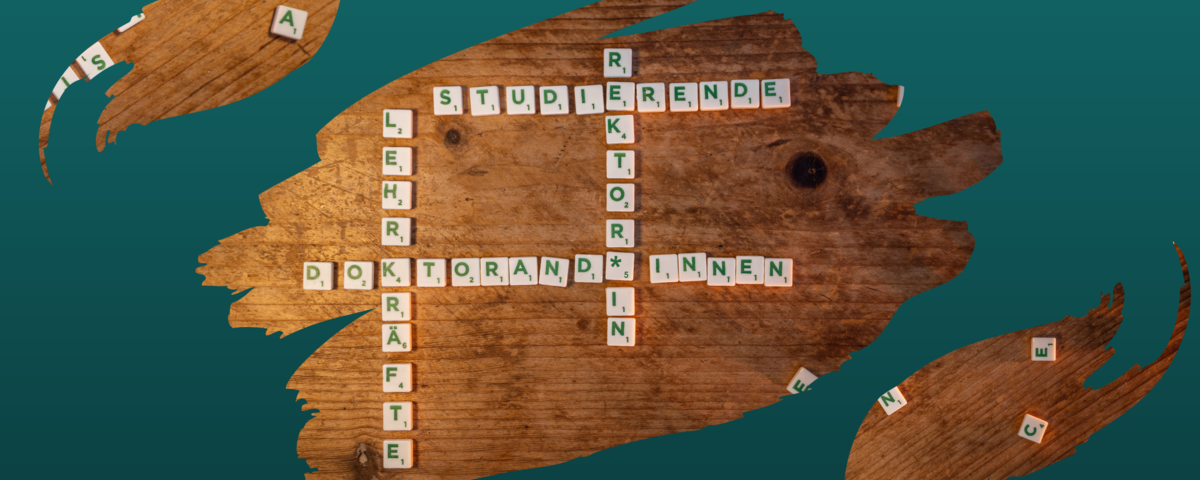
Gender-sensitive language is an important tool for promoting equality: the first step towards achieving a more equitable society is taken by addressing as many people as possible and thereby genuinely taking them into account. Treating genders equally and fairly in language means being aware of the impact of one’s own choice of words and drawing attention to a diverse society. This is the message the University of Greifswald wishes to convey, and it has made gender-neutral language an integral part of its communications. Members of the university are warmly invited to visit this page to find out more about guidelines, the legal framework, recommended reading and other suggestions.
Gender-sensitive wording
The updated guideline 2025
The second edition of the guide to gender-neutral language provides practical and up-to-date guidance on how to use gender-sensitive language confidently and consistently in a higher education context.
It is in line with the binding Senate resolution of the University of Greifswald, which applies to all official documents and official/public communications (further details can be found in the FAQ section at the bottom of the website) within the University of Greifswald and its institutions.
Furthermore, this guide is intended as a source of inspiration and information for all members of the university community who wish to engage more deeply with gender-sensitive language.
The revised version takes into account current social developments, negotiation processes, as well as experiences, feedback and enquiries from university practice.
The english guideline in landscape & portrait orientation
This guide provides:
- explanations and overviews on the use of gender-sensitive language and the gender star,
- practical tips and examples of how to choose appropriate expressions,
- guidance on the use of compound terms (compounds),
- options for the linguistically sensitive use of academic degrees and titles,
- information on recording gender for statistical and administrative purposes,
- Basic guidance on gender-neutral language in English.
- as well as a comprehensive glossary of frequently used terms from the higher education context, which helps readers find their way around quickly.
Note: PDF files are best viewed in two-page mode.
If you have any questions, suggestions or feedback, please feel free to contact us at: gerechtesprache@uni-greifswald.de
FAQ
Which documents are covered by the Senate resolution on gender-sensitive language?
The Senate resolution of 17 April 2019 provides for the implementation of gender-sensitive language in the statutes, the framework examination regulations, the constitution and official documents.
Statutes:
- Entirely new statutes and statutes that have been completely redrafted must be made gender-neutral immediately;
- If an amendment to an existing statute is adopted, the entire text must be amended within three years;
- Irrespective of any amendments, all statutes must be adapted within five years;
- This also applies to the regulations to be adopted by faculties and to the doctoral regulations.
Official documents:
Note: The Senate resolution on gender-neutral language is to be interpreted broadly and therefore requires university departments to use gender-neutral language as extensively as possible. Official documents include, amongst others:
- Forms
- Contracts
- Certificates, documents
- Press and media relations: e.g. websites, leaflets, adverts, magazines, etc.
- Official internal university correspondence, e.g. official letters, etc.
Does the Senate’s decision also apply to student work?
Students’ academic work is not covered by the Senate resolution on gender-sensitive language. Students are not obliged to use gender-neutral language in essays, minutes, theses, etc. Gender-sensitive language is not considered a general formal assessment criterion; accordingly, its (non-)use has no bearing on the awarding of marks.
As a student, you are free to choose whether you wish to use gender-sensitive language and, if so, how you wish to do so.
If you decide to use gender-sensitive language in your work, experience shows that the easiest way to incorporate gender-sensitive writing is to choose a consistent form. If you are unsure about which form to use, you can always consult your supervisor.
The use of a general clause (e.g. ‘For the sake of readability, the generic masculine form is used below; however, all gender identities are, of course, included’) is not recommended. This fails to achieve the aim of taking all gender identities into account – the issue of the invisibility of women* and people with non-binary gender identities is overlooked, and the mental inclusion of these groups tends to deteriorate.
In addition, the relevant member of staff at the Equality Office (see Contact) can help with specific queries regarding gender-neutral language.
Does the Senate resolution of the University of Greifswald also apply to members of the University Hospital?
Decisions taken by the University of Greifswald generally apply equally to Greifswald University Hospital (§ 96 Abs. 2 LHG M-V) of the Higher Education Act of Mecklenburg-Western Pomerania (LHG M-V)) – including the Senate’s decision on gender-neutral language. Furthermore, the Executive Board of Greifswald University Hospital has decided to use gender-sensitive language in official correspondence. This decision complies with the legal requirements set out in § 4 Abs. 2 GlG M-V.
The Equality Office at Greifswald University Hospital has produced a leaflet that deals specifically with gender-sensitive language at the hospital. Here you will find an overview of legal and socio-political requirements, as well as practical guidance to help you use gender-neutral language in the workplace. If you have any questions regarding a specific issue, the staff at the Equality Office will be happy to assist you (gleichstellungumgmed.uni-greifswaldde).
What is the difference between using an asterisk, a colon or an underscore to indicate gender?
All three special characters serve to indicate gender other than the generic masculine and are linguistically represented by a pause (glottal stop).
Whilst students are, in principle, free to choose whether and how to use gender-sensitive language, on 17 April 2019 the University Senate adopted a resolution on the implementation of gender-sensitive language in the University’s statutes, framework examination regulations, constitution and official documents, which stipulates the preferred use of gender-sensitive wording and, where this is not possible, the use of the gender star.
This decision is based on the fact that, in current discourse, the gender star is regarded as the most far-reaching means of implementing gender-sensitive language, as it has been adopted into linguistic usage from its use by trans* communities as a symbol for diverse gender identities and from computer science as a placeholder for arbitrary character strings. It therefore symbolises the ‘infinity of possibilities’. As the only symbol-based form of gender-sensitive language, the gender star therefore also represents gender identities outside the non-binary gender spectrum. At the turn of the year 2023/2024, the German Research Foundation (DFG) announced that, “as part of its ongoing commitment to gender- and diversity-sensitive language use” (Announcement on the DFG website), it would be introducing the gender star in its official communications, thereby sending out an important signal as Germany’s self-governing organisation for science.
Ensuring gender-inclusive language remains an important area of focus.
With regard to people with visual impairments, the German Association for the Blind and Visually Impaired (DBSV) recommends, where possible, avoiding gender-inclusive language that relies on punctuation and instead using neutral phrasing. Given the social importance of gender-sensitive language and the inclusion of gender diversity, it is recommended that the gender star be used where necessary or desired, as it comes closest to being a consensus symbol recognised by most people. (Information taken from the statement issued by the Federal Conference of Women’s and Equality Officers at Universities (Bundeskonferenz der Frauen- und Gleichstellungsbeauftragten an Hochschulen e.V.) on 7 June 2022.)
In addition, the relevant member of staff at the Equality Office (see Contact) can help with specific queries regarding gender-neutral language.
Note for members of the University Hospital:
The UMG Equality Office has produced a leaflet that deals specifically with gender-sensitive language at UMG. It supplements the guidance document with questions and topics arising from work in the healthcare sector.

Sample documents & recommendations
The university’s guidance document is a handbook that can be consulted for any situation. The sample documents and recommendations, on the other hand, are intended to facilitate the use of gender-sensitive language in specific areas – such as addressing individuals or groups of people in a professional context. Members of the university may regard these documents as templates, guidance or inspiration, and use them in their day-to-day work.
Sample documents
Further support and information on gender-sensitive language
Gender Dictionary
Johanna Usinger’s gender dictionary GESCHICKT GENDERN contains over 1,500 entries suggesting gender-sensitive alternatives to terms referring to people in the generic masculine form. The website also offers extensive information on gender-sensitive language. Anyone who hasn’t found what they’re looking for here can use a thesaurus (e.g. from Duden) to search for further creative phrasing.
Practical handbooks and guides
Handbooks make it easier to get started with gender-sensitive language:
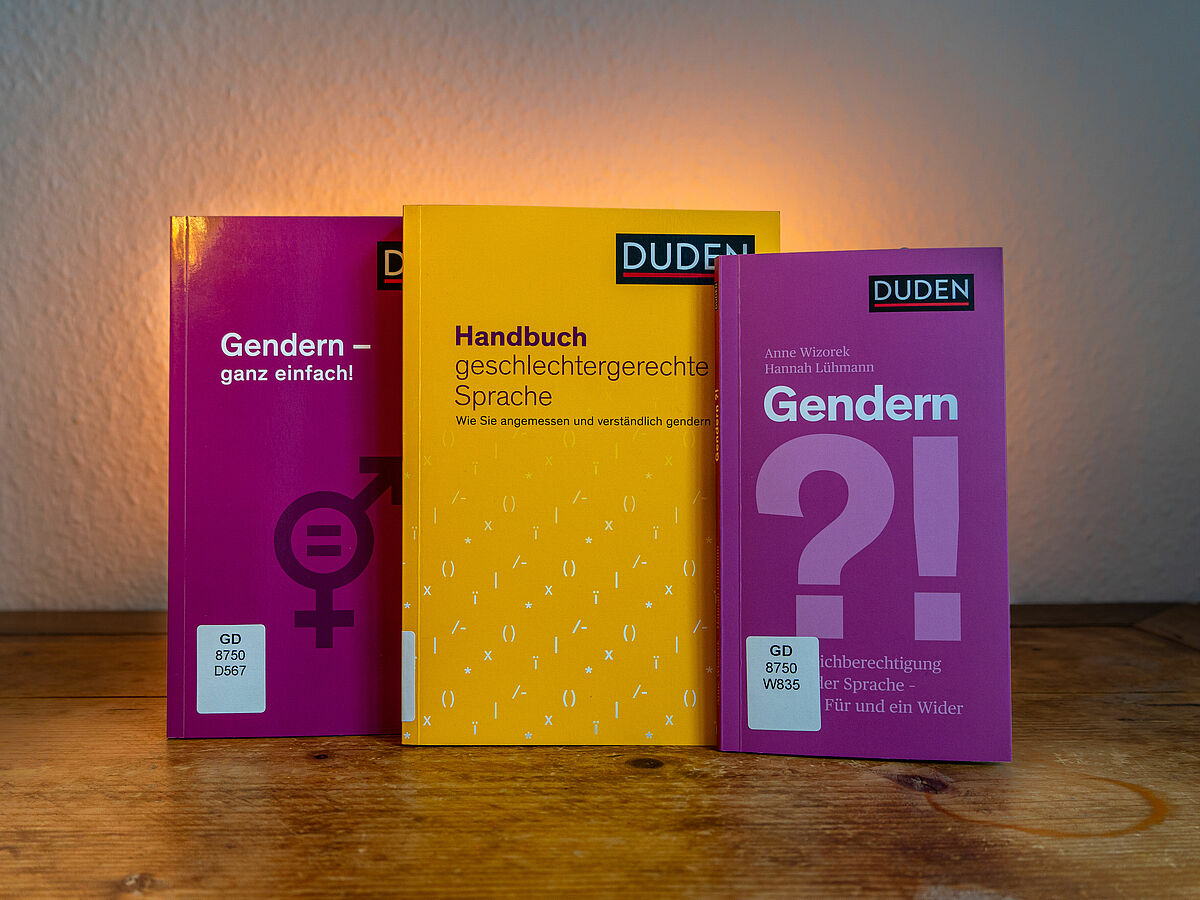
- Gabriele Diewald und Anja Steinhauer (2019): Gendern – ganz einfach! Berlin: Dudenverlag.
- Gabriele Diewald und Anja Steinhauer (2020): Handbuch geschlechtergerechte Sprache. Wie Sie angemessen und verständlich gendern. Berlin: Dudenverlag.
- Lucia Clara Rocktäschel (2021): Richtig gendern für Dummies. Weinheim: Wiley-VCH.
- Lann Hornscheidt und Ja'n Sammla (2021): Wie schreibe ich divers? Wie spreche ich gendergerecht? Ein Praxis-Handbuch zu Gender und Sprache. Hiddensee: w_orten & meer.
- Christine Olderdissen (2021): Genderleicht. Wie Sprache für alle elegant gelingt. Berlin: Dudenverlag.
The PROUT AT WORK Foundation’s guide to gender-inclusive and gender-sensitive language focuses on day-to-day communication in a professional context. Guidance, practical tips and recommendations for action support the use of inclusive language in the workplace. The guide also includes recommendations for the English language and checklists.
The guide to (more) gender-sensitive communication in higher education, respACT, produced by the Centre for the Study of Language and Society (CSLS) at the University of Bern, takes an explicit and practical approach to the contexts and challenges of gender-sensitive communication in higher education and beyond. In addition to a glossary and a list of terms, strategies for gender-neutral language and de-gendering, as well as suggestions for addressing specific aspects of communication in text, imagery and event organisation, the guide places particular emphasis on recognising and including non-binary and trans people in language and within the university – for example, it introduces new pronouns.
Media relations
The Genderleicht project offers comprehensive information on gender-sensitive media work. On the website, you will find
- writing tips,
- a checklist for gender-equitable text production,
- a text lab that devises solutions for challenging practical cases,
- guidance on audio and video formats,
- ...and much more.
These tools come into play right from the planning stage of journalistic pieces and ensure that genders are portrayed appropriately in the media.
Recommended reading
Damaris Nübling und Helga Kotthoff (2018): Genderlinguistik. Eine Einführung in Sprache, Gespräch und Geschlecht. Tübingen: Narr Francke Attempto.
Damaris Nübling (2020): Genus und Geschlecht. Zum Zusammenhang von grammatischer, biologischer und sozialer Kategorisierung. Mainz: Franz Steiner Verlag.
Anatol Stefanowitsch (2018): Eine Frage der Moral. Warum wir politisch korrekte Sprache brauchen. Berlin: Dudenverlag.
Anne Wizorek und Hannah Lühmann (2018): Gendern?! Gleichberechtigung in der Sprache - ein Für und ein Wider. Berlin: Dudenverlag.
Karin Kusterle (2011): Die Macht von Sprachformen. Der Zusammenhang von Sprache, Denken und Genderwahrnehmung. Frankfurt am Main: Brandes & Apsel.
Studies and reports on gender-neutral language
Update: Link to the full text of Ulrike Lembke’s expert report: https://www.rewi.hu-berlin.de/de/lf/oe/asj/gutachten-genderstar-amtssprache_lembke_dezember2021.pdf (last accessed in October 2025).
Additionly: Antidiskriminierungsstelle des Bundes (2024): Standpunkte. Rechtliche Einschätzung staatlicher "Genderverbote". https://www.antidiskriminierungsstelle.de/SharedDocs/downloads/DE/publikationen/Standpunkte/05_genderverbot.pdf?__blob=publicationFile&v=5 . (last accessed in October 2025).
Pabst, Laura/ Kollmayer, Marlene (2023): How to make a difference: the impact of gender-fair language on text comprehensibility amongst adults with and without an academic background. În: Frontiers in Psychology, Vol. 14. DOI: 10.3389/fpsyg.2023.1234860.
Sczesny, Sabine/ Formanowicz, Magda/ Moser, Franziska (2016): Can Gender-Fair Language Reduce Gender Stereotyping and Discrimination?. In: Frontiers in Psychology (2016), Vol. 7. https://doi.org/10.3389/fpsyg.2016.00025 (last accessed March 2022).
Rothmund, Jutta/ Scheele, Brigitte (2004): Personenbezeichnungsmodelle auf dem Prüfstand. Lösungsmöglichkeiten für das Genus-Sexus-Problem auf Textebene. In: Zeitschrift für Psychologie 212 (2004) 1, S. 40-54. DOI: 10.1026/0044-3409.212.1.40 (last accessed January 2023.).
In December 2021, Prof. Dr Ulrike Lembke (Humboldt University of Berlin) prepared a legal opinion on gender-inclusive official language on behalf of the City of Hanover. The legal opinion assesses the legal validity of administrative procedures when the gender star or gender-inclusive formulations are used.
In her expert opinion, Prof. Dr. Lembke concludes that the use of gender-neutral language, including the gender star, cannot have any (negative) impact on the effectiveness or binding nature of administrative actions; on the contrary, it enhances their constitutional compliance.
You can find the full text of the expert opinion here:https://www.hannover.de/Service/Presse-Medien/Landeshauptstadt-Hannover/Aktuelle-Meldungen-und-Veranstaltungen/Gutachten-bestätigt-Genderstar-verwirklicht-Verfassungsauftrag
A summary of the key findings can be found here: https://www.rewi.hu-berlin.de/de/lf/ls/lbk/gutachten-genderstar-amtssprache_ergebnisse_lembke2021.pdf
Suggestions for non-discriminatory language use
The guide “Ausgesprochen Vielfältig” (Extremely Diverse), published by the Co-ordination Office for the Promotion of Equal Opportunities at Saxony’s universities and higher education institutions, goes beyond gender-neutral language. It also provides guidance on language use that minimises discrimination with regard to the following dimensions:
- age
- physical and mental disability
- sexual orientation
- ethnic origin and nationality
- social background
- religion and belief
No longer just implied!
The University of Greifswald uses gender-sensitive language
Following a majority vote, the Senate of the University of Greifswald adopted the following draft resolution at its meeting on 17 April 2019:
“The Senate resolves to implement gender-sensitive language in the statutes, the framework examination regulations, the constitution and official documents.
In doing so, gender-neutral formulations are to be used where possible. Where this is not possible, the gender star shall replace gendered and non-gendered references to persons.”
The University of Greifswald is thus implementing the legal requirements for linguistic equality (§ 4 Abs. 2 GLG MV) and, in line with the Charter of Diversity, is giving tangible expression at the linguistic level to the commitment enshrined in its mission statement to ‘advocate for a liberal, civil and democratic society’.
In addition, the following supplementary provisions were adopted:
“Entirely new statutes, including existing statutes that have been completely rewritten, must be made gender-sensitive immediately. If an amendment to an existing statute is adopted, the entire text must be adapted within three years. Irrespective of any amendments, all statutes must be adapted within five years.”
The initial motions were tabled by the Equality Commission on the initiative of the Equality Officer, with the support and input of the Academic Affairs and Statutes Commission. The relevant documents are available internally on the Senate's website.
Contact

Eliza Meixner
Gender-sensitive language
Domstraße 11, Entrance 4
Room 2.16
17489 Greifswald
Phone +49 3834 420 3491
gerechtespracheuni-greifswaldde