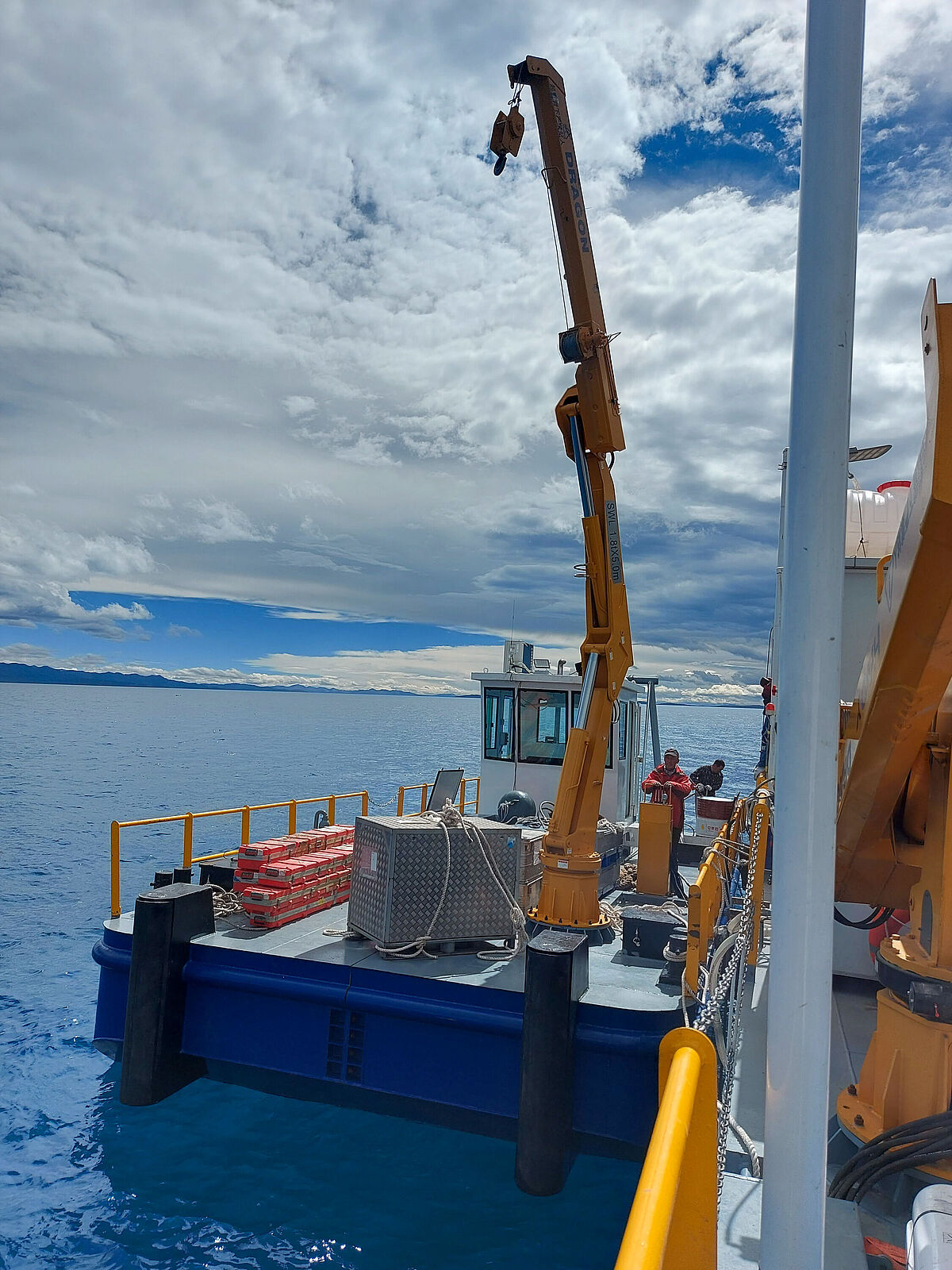
The drilling campaign took place in June and July 2024 and placed high demands on both humans and technology. After setting up a research camp, a specially constructed floating drilling platform was installed on the southern shore of the lake. A total of around 1415 metres were drilled, with the deepest borehole reaching 510.2 metres below the lake bed. More than 50 scientists, technicians and members of logistical staff were involved in the expedition. 950.77 metres of sediment material are now available for further analyses.
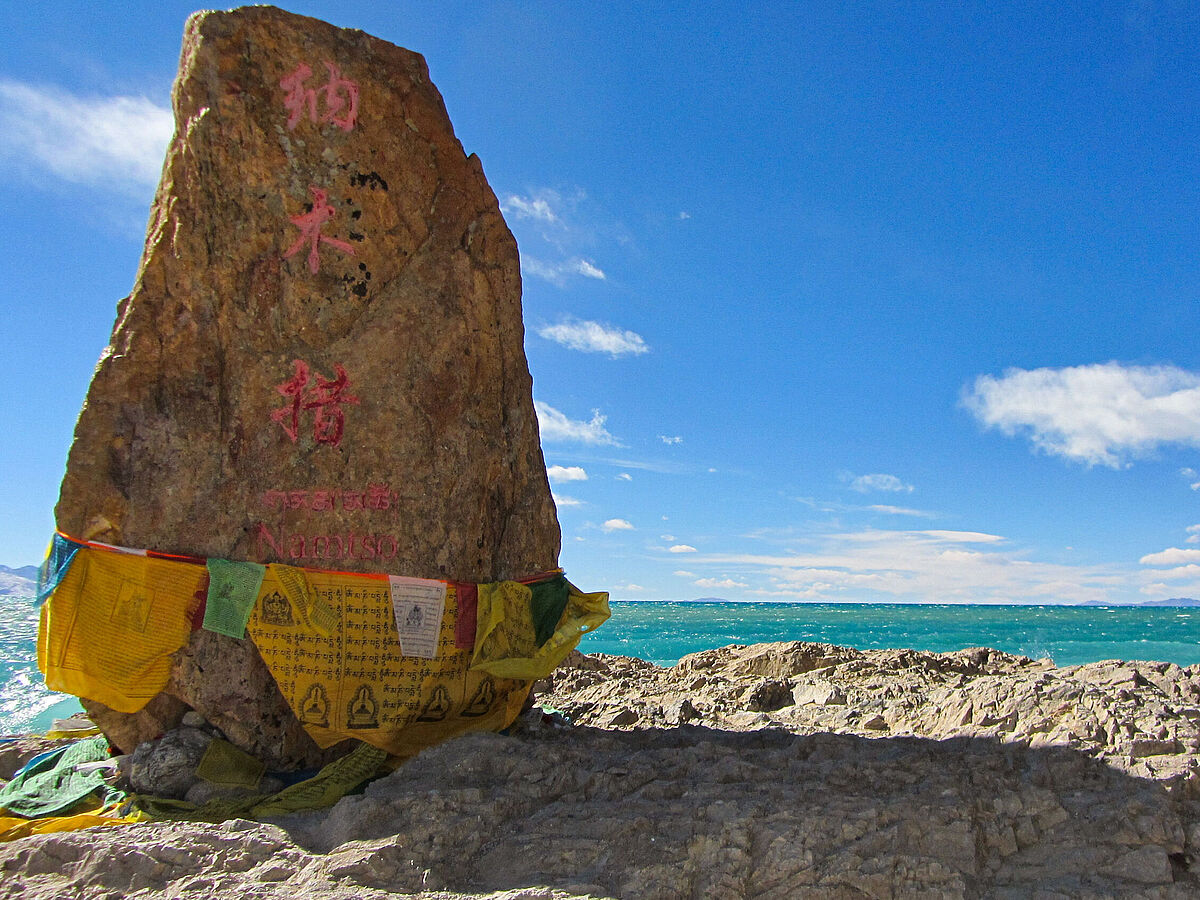
The expedition focussed on Nam Co, one of the largest lakes in Tibet and an important climate archive for Asia. The salt lake, which has no outlet and is around four times the size of Lake Constance, has never fully dried out ever since it was formed. This has allowed continuous layers of sediment to be accumulated over very long periods of time. Due to its location at the interface between the westerly wind zone and the Asian monsoon circulation, the lake is particularly well suited for the reconstruction of climate and environmental changes of the past.
The University of Greifswald played a central role in the drilling and is contributing its expertise in the fields of sedimentology, palaeomagnetics and palaeoecology as part of the international NamCore project. The evaluation of the sediment cores has only just begun and will keep international researchers busy for years to come. The results of the NamCore project should deepen our understanding of Asia's climate history, improve climate models and make it easier to predict the future development of a region that is of vital importance to millions of people.
Further information
On Campus*1456 you can read an in-depth article [de] with a photo gallery of the drilling campaign.
As part of the Swiss National Science Foundation project DIGESTED (Deep biosphere-geosphere interactions at the top of the world) the physical geography research group led by Prof. Dr. Torsten Haberzettl is analysing the sedimentary context in the sub-project, which is coordinated by Dr. Marie-Luise Adolph. Parallel to this, Santiago Otero, M. Sc., is investigating the effects of fluctuations in the Earth's magnetic field on biological communities as part of the DFG-funded MagNam project. In the project funded by the German Research Foundation (DFG), Prof. Dr. Claudia Wrozyna and project team member Dr. Marlene Höhle are investigating fossil ostracodes - tiny crustaceans with calcareous shells - in order to reconstruct the long-term evolution of aquatic communities.
Contact at the University of Greifswald
Prof. Dr. Torsten Haberzettl
Institute of Geography and Geology
Friedrich-Ludwig-Jahn-Straße 16/17 A, 17489 Greifswald
Tel.: +49 3834 420 4502
geo.direktoruni-greifswaldde