
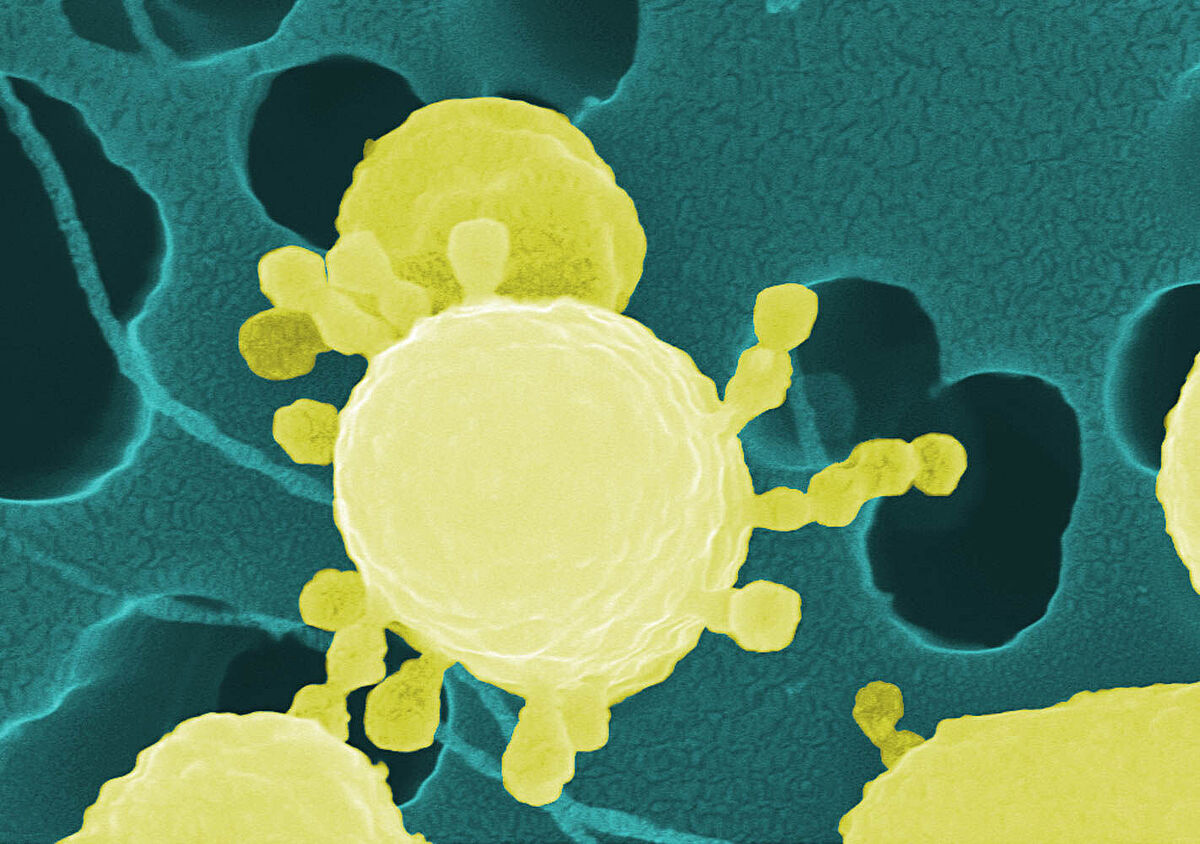
The study centred around fructans – polysaccharide chains composed of many fructose building blocks. Fructans are widespread in terrestrial ecosystems, but their role in the oceans has only been subject to very few investigations in the past. The research team around the lead author of the international study, Dr. Marie-Katherin Zühlke from the University of Greifswald’s Institute of Institute of Pharmacy/Pharmaceutical Biotechnology, was now able to show that fructans can also be found in the oceans and are specifically utilised by certain bacteria. The study was published recently in The ISME Journal (Multidisciplinary Journal of Microbial Ecology).
Marine Gammaproteobacteria, a widespread group of marine bacteria, use a surprising mechanism: two proteins work together to transport the sugar into the cell. In addition to an enzyme from the glycoside hydrolase family 32 (GH32), which splits the fructans into smaller sugar molecules, the researchers also identified a glycan-binding, so-called SusD-like protein. The SusD-like protein recognises and binds the sugar on the surface of the cell. The researchers also found a SusC-like transporter, i.e. a protein that transports the sugar through the cell envelope.
In bacteria belonging to the phylum Bacteroidota – a large group of bacteria to which many intestinal bacteria belong – SusC/D-like proteins usually form a complex that transport large sugar molecules into the cell. Such transport systems were previously unknown in marine Gammaproteobacteria. The analysis also showed that these SusC/D-like transporters in marine Gammaproteobacteria are only found together with fructan-specific GH32 enzymes. “This suggests that these microorganisms have specialised in utilising these sugars,” explains Zühlke, who led the study as head of the junior research group in the Collaborative Research Centre CONCENTRATE.
“Our results show that SusC/D-like glycan transporters are not exclusive to the Bacteroidota phylum,” adds Prof. Dr. Thomas Schweder, Spokesperson of CRC 420 CONCENTRATE. The findings of this study show that fructans make a previously underestimated contribution to the marine glycan pool and are utilised in the oceans by specialised microbial communities.
Further information
Publication: Zühlke, M.-K.; Bahr, A.; Bartosik, D.; Solanki, V.; Teune, M.; Welsch, N.; Unfried, F.; Barbeyron, T.; Ficko-Blean, E.; Schoppmeier, P.; Schiller, L.; Busse, N.; Banerjee, D.cladière, L.; Jeudy, A.; Susemihl, A.; Hartmann, F.; Jouanneau, D.; Jam, M.; Höhne, M.; Delcea, M.; Reintjes, G.; Bornscheuer, U. T.; Becher, D.; Hehemann, J.-H.; Czjzek, M.; Schweder, T.: Fructan utilization by members of marine Gammaproteobacteria involves SusC/D-like proteins. The ISME Journal 2026 DOI: doi.org/10.1093/ismejo/wrag030
The results of the first study from the Collaborative Research Centre TRR 420 CONCENTRATE were published in the journal The ISME Journal (Multidisciplinary Journal of Microbial Ecology).
The Collaborative Research Centre/Transregio 420 CONCENTRATE is a research consort involving the Universities of Greifswald and Bremen and further research institutes and is funded by the German Research Foundation (DFG). TRR 420 concentrates on interdisciplinary fundamental research on the biology of marine glycans with the aim of elucidating the complexity of glycan compounds in the oceans and understanding the underlying processes that manage the equilibrium between sugar degradation and carbon capture.
Contacts at the University of Greifswald
Dr. Marie-Katherin Zühlke
Institute of Pharmacy/Pharmaceutical Biotechnology
Felix-Hausdorff-Straße 3, 17489 Greifswald
Tel.: +49 3834 420 5949
marie-katherin.zuehlkeuni-greifswaldde
www.linkedin.com/in/marie-katherin-zühlke-528224156
Prof. Dr. Thomas Schweder
TRR 420 CONCENTRATE Spokesperson
Institute of Pharmacy/Pharmaceutical Biotechnology
Felix-Hausdorff-Straße 3, 17489 Greifswald
Tel.: +49 3834 420 4212
schwederuni-greifswaldde