
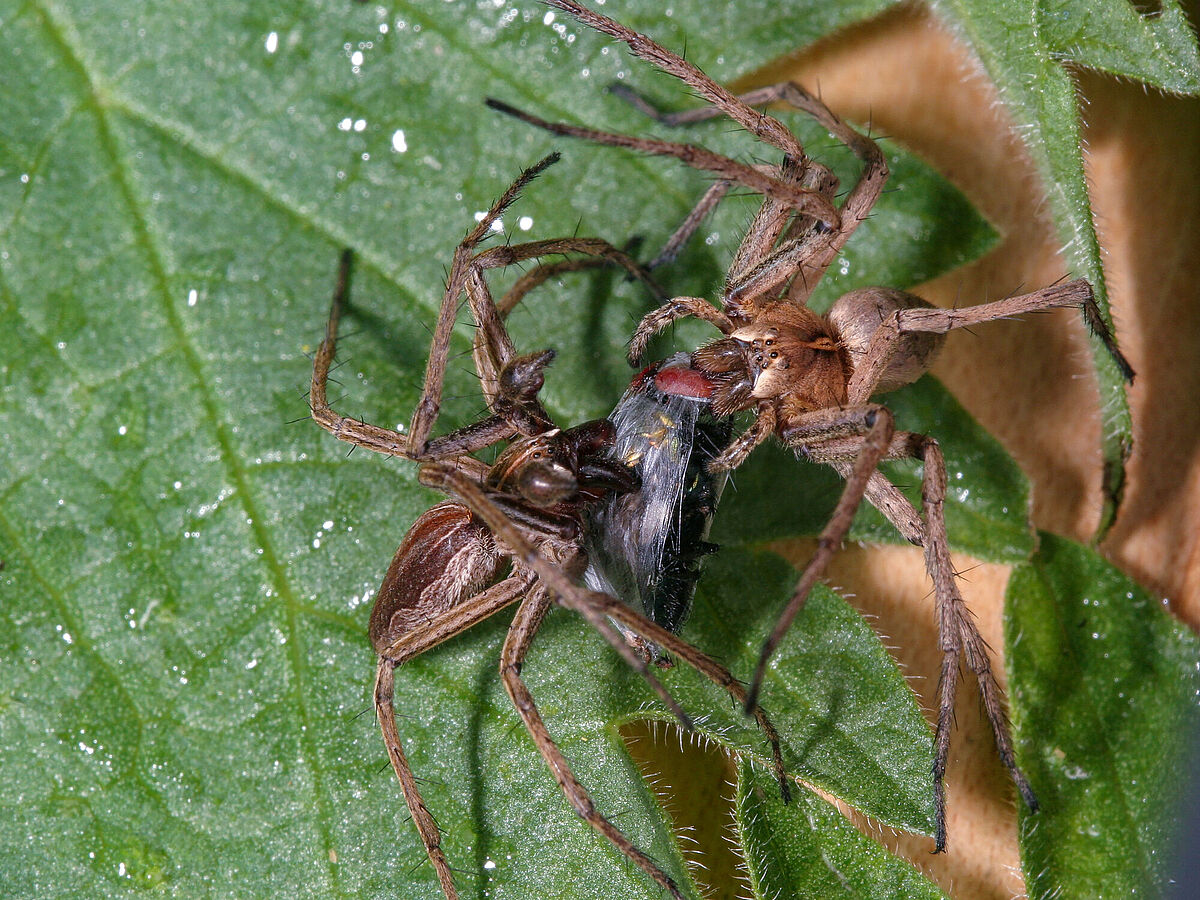
Scent is crucial - even for spiders. The research team led by Mohammad Belal Talukder at the University of Greifswald made a remarkable discovery that was recently published in Communications Biology: male nursery web spiders use their legs to pick up the scent of females.
It is well known that insects perceive their environment via chemosensory hairs, so-called sensilla. However, very little research has been performed on spiders’ chemosensory tools. In a study published at the beginning of this year, the research group led by Gabriele Uhl, Professor of Zoology at the University of Greifswald, demonstrated for the first time that orb-weaver spiders have two types of sensilla: like insects, they have sensilla for tasting (tip-pore sensilla) and for smelling (wall pore sensilla). However, the “olfactory hairs” (wall pore sensilla) were only found on the legs of adult male orb-weaver spiders.
The current study paints a similar picture for the nursery web spider - which roams its surroundings to hunt and does not build webs: only males have “olfactory hairs”.
The structure and position of the hairs provide information on their function
The researchers used high-resolution electron microscopy to investigate the position, shape and cellular structure of the nursery web spiders’ sensory hairs. Mohammad Belal Talukder, first author of the study, explains: “Having identified where the hairs are located, we looked at how the spiders move on different surfaces, such as leaves or grass, how they catch prey, or mate. We then compared which parts of their legs come into contact with the surfaces or their partners.”
The result: the wall pore sensilla on the males’ legs are distributed in such a way that they do not touch surfaces or the female. This leads to the conclusion that they are used for the perception of airborne substances - i.e. for smelling. The tip-pore sensilla, however, which occur in both sexes of the nursery web spider, come into contact with surfaces. This is how the spiders process taste information.
Males “follow their nose”
The Greifswald research group set up an experiment to investigate whether the male nursery web spider uses its distinctive olfactory apparatus to track down females: “We placed a female at one end of a y-shaped glass tube system. The other end remained empty,” explains master's student Vedanti Mahimkar. “We gave the female two hours to acclimatise and then placed a male at the fork in the glass tube.”
The team observed which path the male chose: did he veer toward a potential partner or toward the empty end? The males proved they “follow their nose”: 80 percent made their way to the source of female scent – and quite quickly.
New findings on arthropods
Until now, it was unknown that male nursery web spiders were able to smell potential mates from a distance. “I see the study as an important piece of the puzzle in basic research into understanding which sensory organs arthropods have, how they taste and smell, how they perceive pheromones and how they find each other to reproduce,” says Prof. Dr. Gabriele Uhl, head researcher of the study.
Further information
Angaben zur Publikation: Talukder, M.B., Müller, C.H.G., Fischer, A. et al. The chemosensory toolkit of the cursorial spider Pisaura mirabilis. Communications Biology (2025), https://doi.org/10.1038/s42003-025-09127-z.
Prof. Dr Gabriele Uhl
Department of General and Systematic Zoology
https://zoologie.uni-greifswald.de/en/organization/departments/general-and-systematic-zoology/
Contacts at the University of Greifswald
Prof. Dr Gabriele Uhl
Head of Department Zoological Institute and Museum
General and Systematic Zoology
Loitzer Str. 26
17489 Greifswald
Tel.: +49 3834 420 4242
gabriele.uhluni-greifswaldde
Mohammad Belal Talukder, Research Assistant (doctoral candidate)
Zoological Institute and Museum
General and Systematic Zoology
Soldmann Str. 14
17489 Greifswald
Tel.: +49 3834 420 4265
talukdermuni-greifswaldde