Energy and Campus Management
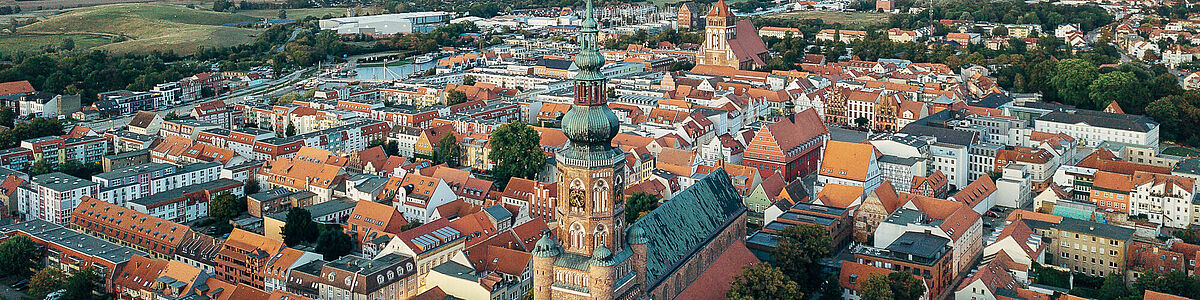
The University of Greifswald has four sites: the historic campus centred around the Main University Building, the Loefflerstraße Campus, the Soldmannstraße Campus, and the Berthold-Beitz-Platz Campus.
The inventory includes 115 buildings with a total floor space of approximately 167,000 square metres and more than twice that amount in land area. Operating this large number of buildings poses major challenges for the university, not least in view of its sustainability target of achieving carbon neutrality by 2030.
Every year, the University of Greifswald consumes around 10–12 gigawatt hours of heating. That is equivalent to the heating demand of around 600 detached family homes. Between 2021 and 2024, heat consumption – adjusted to allow for the weather conditions – was reduced by approximately 15 per cent. The annual electricity consumption is approximately 10 gigawatt hours. This corresponds roughly to the consumption of approximately 2,500 four-person households. Substantial savings have not yet been achieved in the area of electricity. It is therefore particularly important to purchase high-quality, fossil-free green electricity.
In particular, the use of district heating causes large quantities of GHG emissions as it is still predominantly generated from fossil fuels. Overall, GHG emissions of 2,759 tonnes of CO2 equivalents were calculated for the “Energy” field of action (electricity, heat) in 2024. This is on a similar scale to the purchasing sector.

![“Save Energy” campaign [de]](/storages/uni-greifswald/_processed_/d/5/csm_2024-11-19_Desktop-Personenkampagne-Rektorin-F1_f2fad9bd48.jpg)