Mobility
Transport associated with the university mainly comprises passenger mobility, i.e. trips across the campuses or as part of work-related travel and student excursions, as well as commuting. In addition, journeys are made for technical operations, such as deliveries, services or waste disposal.
Around 7,000 trips related to work-related travel take place each year, resulting in greenhouse gas emissions of just under 1,000 tonnes. That corresponds to approximately 17 per cent of the university’s overall calculated net greenhouse gas emissions. In terms of the number of journeys, travel by train is just ahead of travel by car; in terms of greenhouse gas emissions, travel by aeroplane leads by a wide margin, accounting for around 80 per cent of the harmful emissions in the mobility sector.
The university’s vehicle fleet consists of 24 cars and eight minibuses, including three electric cars and one natural gas vehicle (status 2026). In addition, the university provides 20 employee bikes and one cargo bike.
Cycling in Greifswald

Greifswald is predestined as a cycling town thanks to its compact layout, short distances, and only gentle slopes; it has a good, steadily improving cycling infrastructure, and a high density of cyclists.
The University systematically promotes cycling: it is continuously expanding its parking areas for bikes and systematically equipping them with modern bike racks. Some of these parking areas are covered. Transport infrastructure, and in particular cycling infrastructure, are the focus of research projects and final-year theses at the university and form an important part of the town's climate protection strategy.
The University of Greifswald, together with the university and Hanseatic town of Greifswald, and University Medicine Greifswald, is supporting the expansion of the cycling infrastructure as part of the collaborative project “GEKLIB – Gesundheit und Klima in Bewegung” [de] The project not only improves the transport infrastructure, but also promotes sustainable and climate-friendly mobility. In addition to the infrastructure, GEKLIB focuses on information, public participation, and practical offers. Plans include mobility action days, repair workshops, group cycling tours, and communication campaigns centred on the themes of health, climate protection, and sustainable mobility.
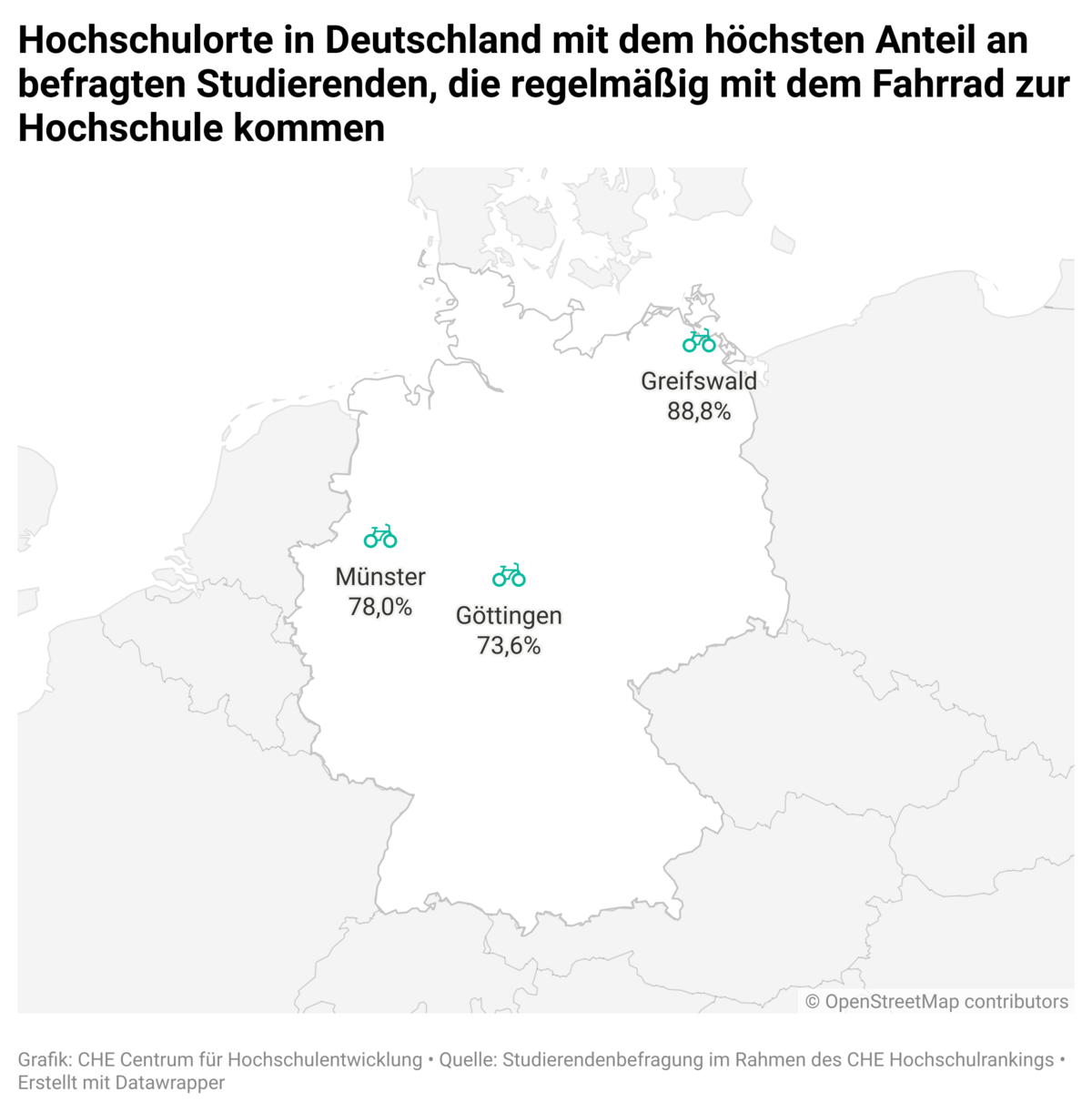
Almost 90 per cent of the students in Greifswald use their bikes to get to the university and about 40 per cent walk. Only two percent use public transport. Similarly, only five percent arrive by car or motorbike. The Germany-wide average for cycling is around 34 percent; 30 percent walk and 26 percent arrive at the university by car or motorbike.
This was the result of the 2023 study Residential situation and mobility of students at individual university locations in Germany [de] carried out by the CHE Centre for Higher Education. The data is based on a survey of more than 80,000 students in undergraduate degree courses in their third subject semester and above. Multiple answers were allowed for the question regarding the means of transport, which is why the percentages can add up to more than 100 percent.