Sustainability in Purchasing and Procurement
Public procurement also offers the opportunity to place emphasis on fair and sustainable, as well as environmentally friendly products. The University can set a good example here too!
According to calculations, the procurement sector amassed GHG emissions of 2,886 tonnes of CO2 equivalents in 2024. This accounts for almost half of the university’s net greenhouse gas emissions. Therefore, at the University of Greifswald, sustainability considerations and standards are playing an increasingly important role in the procurement of devices, computer equipment, furniture, chemicals, office supplies, and services. For example, when purchasing computer equipment, fridges and other household appliances, attention is paid to energy-saving technology. Furthermore, preference is given to furniture, devices, and office supplies that carry environmental certifications such as the Blauer Engel (Blue Angel). Care is also taken to ensure that products have sufficient durability.
GHG accounting in the procurement sector poses a particular challenge, as the collection of climate-relevant data is complicated and requires a significant amount of effort due to the large number and variety of purchased goods, as well as the high volume of contracts and orders. The list ranges from IT and laboratory equipment to fridges, furniture, office supplies and chemicals, to waste disposal, and also includes a wide range of services.
The path to sustainable procurement
The most effective way to conserve resources is to only purchase items, devices or services with specifications that sufficiently meet your genuine needs. Accordingly, the procurement process begins with a description of requirements that should be as functional as possible so that the goods or services purchased are ideally suited to their intended purpose.
The following aspects should be considered:
- Is there a genuine need? Which features are actually necessary?
Only essential items should be purchased. Unnecessary purchases should be avoided if tasks or projects can be completed with the existing resources. Similarly, unnecessary add-ons should not be purchased. The fewer resources a product uses, the more sustainable it is. It also makes sense to prioritise the required functions. - Can the need be met any other way?
Recycling, exchanging or borrowing the required items may be an alternative option in certain circumstances. Sharing existing resources also prevents unnecessary redundancy. - Are the life-cycle costs known?
A simple price comparison based on purchasing costs overlooks ongoing maintenance costs, which in some cases far exceed the purchasing amount; this is why it is essential to take life-cycle costs into account. - Does the desired product pose any social and/or environmental risks?
Many products are manufactured in global production processes involving numerous production stages. Environmental and social malpractices can occur at various points along the way. The market power of public procurement departments should be leveraged as effectively as possible to prevent unfair working conditions and environmental abuse in the manufacturing process.
The procurement of a sustainable service or sustainable device begins by taking sustainability aspects into account when specifying the terms for the bidding process. The specifications and/or statement of work must indicate which functional, technical, aesthetic, and also environmental aspects the service or product must fulfil.
The product to be purchased should fulfil its intended purpose as effectively as possible. To achieve this, the buyer must define the basic minimum technical or functional requirements (known as exclusion criteria). The purchase of a product will only be considered if these are met. By incorporating environmental criteria, we can save on raw materials and energy whilst simultaneously reducing waste and environmental pollution. The criteria belonging to certain certification labels (e.g. Blue Angel, Energy Star, FSC, etc.) can serve as a guide.
Set out the criteria for awarding the contract, e.g. energy efficiency for electronic equipment, certain amounts of specific raw materials, etc., and determine their weighting in the evaluation of tenders. The award criteria must relate to the subject of the invitation to tender. The invitation to tender must describe how life-cycle costs are assessed and weighted.
Specifications regarding the fulfilment of the contract are another way of incorporating energy or environmental requirements into the procurement process. These include, for example, requirements regarding packaging, shipping, returns, or disposal.
From among the tenders received, the most economical tender will be selected from those that meet all of the technical requirements. The most economical tender is not necessarily the cheapest, but rather the offer that meets the award criteria best – i.e. it is the tender that offers the best value for money, including the environmental criteria set out in the invitation to tender.
From exclusion criteria to award criteria
When awarding contracts or issuing invitations to tender, it must be made clear whether the specified requirements constitute an exclusion criterion or a soft criterion:
- Exclusion criterion: (Hard criterion). Also known as a minimum requirement. Describes the minimum requirements that must be met by the goods or services being offered or procured. A tender will not be considered if these have not been met.
If sustainability criteria are defined as exclusion criteria in the search for offers or invitation to tender, tenders that do not meet these criteria will not be considered. This is the most effective way of implementing the demand for sustainable purchasing. However, the problem here is that this may result in a lack of tenders, or very few to choose from. Where sustainability criteria are already standard practice for certain types of product (e.g. ENERGY STAR for electronic devices or FSC/PEFC certification for wooden products), the corresponding underlying standards should always be set as minimum criteria. In areas where sustainability certifications are currently scarce (e.g. eco-labels for IT equipment), it is therefore better to define them as award criteria instead.
- Soft criterion (award criterion): Award criteria are used to weight offers. This concerns, for example the degree to which certain objectives or thresholds are met. This means that, in addition to the price of the tender, other factors can also be taken into account. The advantage of using award criteria is that they can be ranked according to the degree to which they are met.
With regard to sustainability aspects, it always makes sense to select award criteria where environmental labels or similar are rarely or never used in a specific product group. If, for example, the “Blauer Engel” criteria were set as minimum or exclusion criteria for procuring IT equipment, there would be no products to choose from. With a view to practical feasibility in such contexts, it makes more sense to use weighted award criteria to give greater weight to those suppliers who already implement at least some aspects of environmental certifications than to exclude them entirely.
Best value means lowest price? No! – The legal framework for sustainable purchasing
Unlike private purchases, the University of Greifswald, as a public institution, must comply with extensive regulations when procuring goods and services. The primary aim of these regulations is to prevent unjustified interference in the competition between businesses. Sustainability does not have to conflict with this. It is important that the principles of purchasing and public procurement law are observed. These include: transparency, equal treatment, the free movement of goods and freedom of establishment; and environmental and social aspects may also be taken into account (§ 97(3) of the Gesetz gegen Wettbewerbsbeschränkungen (Competition Act)).
Legal framework in Mecklenburg-Vorpommern
The incorporation of sustainability criteria and social and societal aspects in the procurement process is also reflected in the relevant laws and guidelines “Public contracts and concessions shall be awarded on a competitive basis and through transparent procedures. In doing so, the principles of cost-effectiveness and proportionality shall be upheld” (§ 3(1) VgG MV).
§ 97(3) of the Competition Act
“In making the award, aspects of quality and innovation as well as social and environmental aspects shall be considered in accordance with this Part.”
§ 5 of Mecklenburg-Vorpommern’s Vergabegesetz (Public Procurement Act)
(1) Contracts shall only be awarded to competent, capable, law-abiding and reliable businesses (suitable businesses).
(2) Additional requirements may be imposed on contractors in relation to the performance of the contract, concerning in particular social, environmental or innovative aspects, provided they are linked to the subject of the contract. […] The conditions of performance must be set out in the contract notice or the procurement documents.
§ 9 of Mecklenburg-Vorpommern’s Public Procurement Act
(4) The State and local authorities shall only award contracts to businesses if the latter undertake, by means of a declaration to the contracting party, to pay their employees a minimum hourly rate […] whilst they are performing the service.
§ 11 of Mecklenburg-Vorpommern’s Public Procurement Act
“When awarding services, steps must be taken to ensure that the services do not involve any goods that have been produced or manufactured in breach of the minimum standards laid down in the core labour standards of the International Labour Organization (ILO).”
Exclusion list for procurement
Due to their poor environmental impact, the following products or product groups should, as a general rule, not be procured:
- appliances for preparing hot drinks using single-serve packaging (e.g. coffee machines with capsules) These result in an enormous consumption of packaging materials.
- Drinks in single-use packaging, even if they are subject to a deposit charge (Pfand). This does not apply to cardboard or flow wrap packaging.
- Single-use packaged products
- Wood and products made from or containing wood without proof of legal and sustainable forest management.
Protecting the environment through framework agreements
Purchasing goods in large quantities can make sense from an economic perspective if bulk discounts are available. However, the associated warehousing can be detrimental both environmentally and also economically. In addition to taking up space and the maintenance costs for storage facilities, goods that have specific temperature requirements (e.g. chemicals or biological materials) can prove particularly problematic.
Therefore, a comprehensive approach should be adopted when purchasing large numbers of products that are not to be used immediately. Bulk discounts can quickly be cancelled out many times over by storage and energy costs.
Particularly when planning to purchase large quantities of a specific good, the public sector’s market power can be used to address both economic and environmental aspects.
Rather than making a one-off purchase of large quantities that will be stored long term, it is better to draw up a framework agreement. This allows goods to be ordered in line with the agreed terms when they are actually needed.
The advantages are clear:
- the prospect of receiving large orders over an extended period of time offers potential for negotiating price reductions.
- Energy-intensive and space-consuming storage is avoided as the purchased goods can be ordered whenever they are actually needed
A wide range of framework agreements [de] is already available for various product groups. If no such framework agreement is in place and recurring quantities of specific goods or products are required, please contact the Purchasing Department.
Taking full account of costs: life-cycle costs
The most obvious criterion, and often the first to be considered when selecting a product or service, is the purchase price. However, there are further costs beyond the purchase price itself: follow-up costs arising from usage, the consumption of operating materials or consumables, the energy required, as well as maintenance and disposal costs. The costs arising from external effects (e.g. environmental impact) are even less obvious. Such costs must also be taken into account.
Both obvious and less obvious costs can be incorporated in the evaluation by calculating life-cycle costs. Taking life-cycle costs into account is feasible under public procurement law, provided that the method and factors are defined accordingly in the specifications of service.
Life-cycle cost calculator
The life-cycle cost calculator allows you to calculate the actual costs of a product quickly, using a simplified calculation method. To do this, you enter the acquisition costs (e.g. the purchase price), including the costs of provision (delivery, installation, etc.). Then add the expected duration of use or its service life. Particularly the electricity consumption of many technical devices can be specified in kWh. Based on this, the ongoing operating costs are calculated on the basis of the current electricity price (as of 2022) and a typical rate of increase in electricity prices. Annual repair or maintenance costs, as well as material costs (e.g. new toner cartridges for printers), can and should also be factored in, as these costs become increasingly significant the longer the service life.
When comparing several products, the service life is a particularly crucial factor. If there is no difference in the service life (i.e. same duration), the offer or product with the lowest life-cycle costs (corresponding to the discounted total costs) is the most economical. Where service lives vary in length, the offer or product with the lowest annuity is the most economical.
Depending on the product, good or service, different values must be taken into account and factored into the life-cycle costs in order to obtain as comprehensive and accurate a picture of the actual costs over the entire service life as possible.
The German Environment Agency provides tailored tools and aids to help with assessments being performed specifically for individual product groups: Tools and aids from the German Environment Agency.
It is important to bear in mind that the calculation of life-cycle costs is always only a rough estimate of a product’s actual costs. The factors taken into account (e.g. electricity prices, pricing trends, discount rates) and the actual service life may, and indeed will, differ in reality from the assumed values. Particularly in the case of devices that are especially maintenance-intensive or consume large amounts of electricity or materials during their operational phase, it makes sense to base the selection on life-cycle costs, as the costs incurred over the life cycle have a significant impact.
Environmentally friendly and socially responsible procurement
Many products are manufactured across the world in various production stages. Complex, multi-layered production processes across different countries carry the risk that products may be manufactured under poor environmental and social conditions. This risk is all the greater when products or the required raw materials originate from countries with less strict labour or environmental protection standards. Sustainable procurement also means preventing social and environmental exploitation in the production of required products and keeping an eye on production and resource-related risks to people and the environment.
Keeping an eye on social and environmental risks
Before buying products that may pose social or environmental risks, the associated challenges should be taken into account and addressed with potential solutions within the procurement process.
Sensitive product groups and resources used that may present risks include:
- Textiles and goods manufactured from them
- Agricultural products
- Products made from or containing wood, rock flour or (natural) rubber
- Leather goods and tanned products
- Natural stones
- Sports equipment
- Carpets
- Information and communication technology
Environmental labels and certifications can play an important role in identifying environmentally and socially responsible products or resources. Furthermore, thanks to the criteria behind certain meaningful labels, it is possible to issue invitations to tender and to procure sustainable products. The University aims to increase the use of eco-labels in both central and decentral procurement. However, given the wide variety of possible product labels, not every label, or specifically, environmental certification, is equally effective or appropriate when it comes to achieving our sustainability goals.
It is easy for you to check whether a particular label actually stands for sustainable products or the sustainable use of resources: via the label directory of the Deutsche Gesellschaft für internationale Zusammenarbeit (Siegelklarheit.de) or via the offers provided by the Bundesverband der Verbraucher Initiative (Label-online.de [de]). Particularly in decentralised procurement, those responsible should only purchase products bearing reliable and recommended environmental or sustainability labels.
The most important eco-labels at a glance
There is a wide variety of environmental and sustainability labels, most of which are specific to a particular product group. The selection of environmental certifications listed below always corresponds to a good choice, whether for purchases at the university or for personal use.
Further important labels
In addition to environmental labels, other labels can also help when selecting sustainable products. These include:
- the EU energy label: this label, with a colour scale ranging from red (G – very inefficient) to green (A – very efficient), helps you identify electrical devices with low energy consumption.
- the EU organic logo: this identifies agricultural products that are grown in accordance with the criteria set out in EU regulations on organic farming.
Implemented measures
Furniture and furnishings
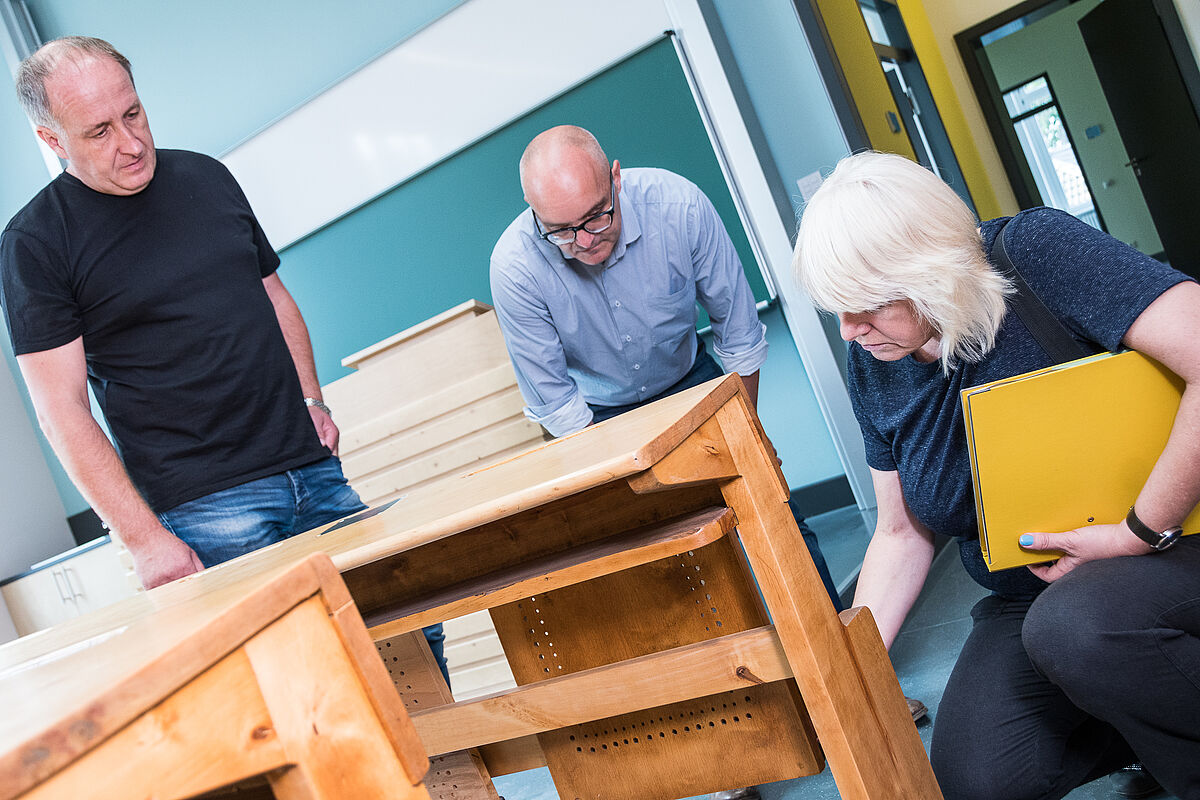
The furniture used at the university and purchased via the existing framework agreement meets the European LEVEL 3 standards and is characterised by its exceptional social and environmental sustainability.
The procurement process starts with a specific need. Only furniture that is actually required should be purchased. Before purchasing new items, it may be possible to reuse existing items from other organisational units. Furniture that is currently available can be found on the furniture exchange [de].
If new furniture is required, it can be purchased through the existing framework agreements [de]. The framework agreements that have been concluded ensure that purchases are made in a resource-efficient and environmentally friendly way.