Research, Teaching and Transfer
Sustainability in research
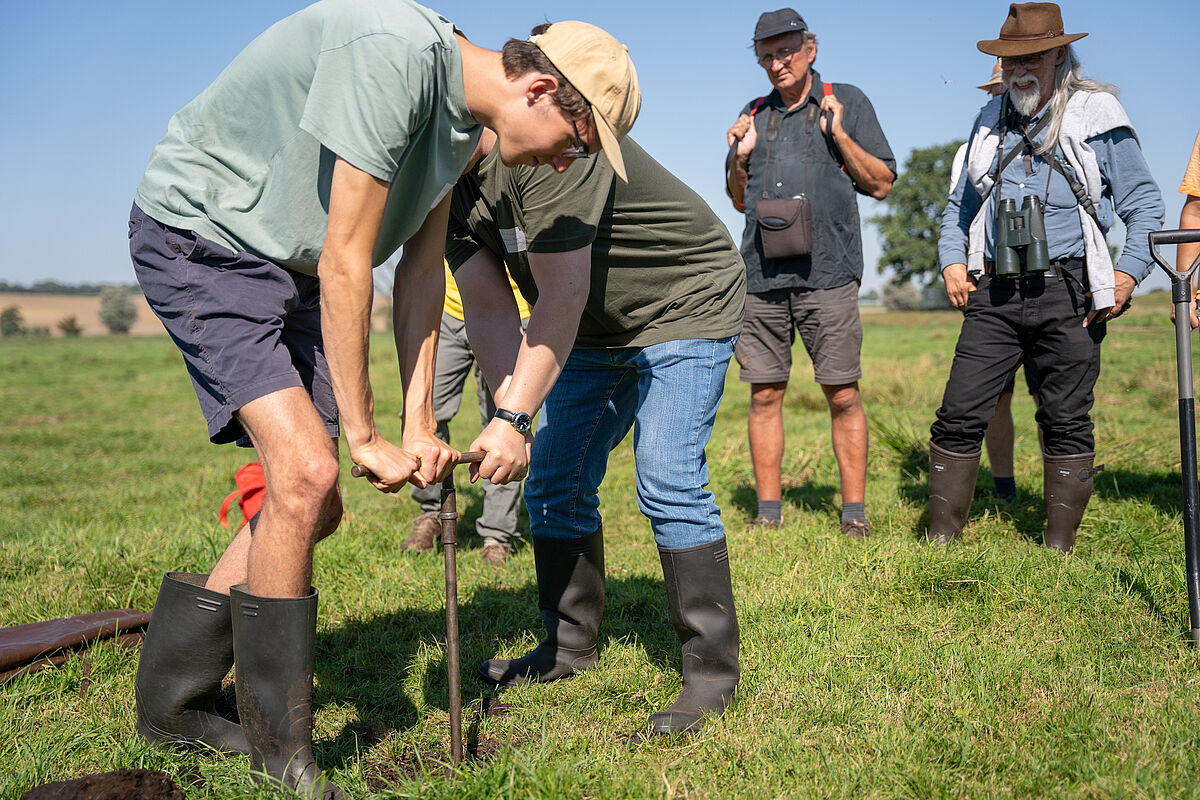
Sustainability is an important area of research at the University of Greifswald. This is shown by the large number of research projects that are directly connected to sustainability. The Research Strategy is guided by the maxim “Environment & Society in Transition – Challenges & Solutions”. It has three interfaculty research domains (“One Health”, the “Baltic Sea Region”, and “Prevention”) underpinned by 12 well-established interdisciplinary key research topics. These include the key research topics of “Bioeconomy’’, “Rural Areas’’, “Peatlands, Coasts & Oceans” and “Environmental Change”.
Sustainability in teaching
Sustainability is evident in many ways in studies and teaching at the University of Greifswald. Ten of a total of 100 degree courses (three at bachelor’s and seven at master’s level) have a clear sustainability focus. Traditionally, there is a particularly strong ecological component to our degree courses, but the study programmes in the humanities, cultural studies and social studies also offer modules on sustainability topics, such as the General Studies module “Interdisciplinary Sustainability".
Sustainability in knowledge transfer
Sustainability has been an important component of the research profile and transfer activities for many years. This is shown by the abundance and diversity of research projects that focus on sustainable development issues. As an important player in sustainable development, the University of Greifswald acts as a link between the region and national and international partners, and processes in a globally connected, rapidly changing world (third mission).
In its Transfer and Innovation Strategy, the University of Greifswald committed itself to promoting the sustainable development of the region's dominant economic sectors, agriculture and tourism, especially in the creation of new value chains, for example in the field of bioeconomy. From the University's point of view, the challenge is about working together closely with neighbouring higher education institutions, research institutes, businesses, society, and public administration to solve regional problems and develop a strong science region.
Sustainability Prize

The Rectorate, the Senate’s Sustainability Committee, and the University of Greifswald’s Sustainability Officer award the Sustainability Prize every year. The prize recognises outstanding undergraduate theses and doctoral theses that deal with the topic of sustainability in a particularly significant way. The prize money amounts to € 500.
Previous winners of the Sustainability Prize
- 2026: Dr. Lucas Hennicke (doctoral thesis): “Hybride Treibhausgasbepreisung - Systematisierung und verfassungsrechtliche Bewertung” and Dr. Yannick Branson (doctoral thesis): "Enzymatic Degradation of Synthetic Polymers"
- 2025: Tanja Narjes (B.Sc. thesis): “Eine Pilotstudie zur Quantifizierung des Energieeinsparpotenzials durch einen Aufruf zur Verbrauchsreduktion in Gebäuden der Universität Greifswald”.
- 2024: Oliver Karl Dittmann (B.Sc. thesis): “Pilotstudie zur Entwicklung eines Informationssystems zur Energienutzung für Gebäudenutzer der Universität Greifswald”.
- 2023 [de]: Dr. Henrik Terholsen (doctoral thesis): “Enzymatic valorization of sustainable carbon sources”.
- 2022: Dr. Sabine Wichmann (doctoral thesis): “The economics of paludiculture: Costs & benefits of wet land use options for degraded peatlands – with a focus on Reed and Sphagnum moss”
- 2021 [de]: Johanna Czichowski (B.Sc. thesis): “How does the individual’s responsibility compare with those of industry, government, and the media in the effort to mitigate the climate crisis?” and Katharina Pickl (B.Sc. thesis): “Die Biodiversität in Privatgärten und das handlungsbasierte Wissen der Gartenbesitzer: Eine Studie zur Gartenkultur in Ingolstadt”
- 2020 [de]: Johanna Braun (M.Sc. thesis): “Sustaining Global Food Supply within the Planetary Boundary for Freshwater Use – A quantitative Analysis on the Potentials of Dietary Changes”
- 2019 [de]: Julia Merkelbach (M.Sc. thesis): “Erstellung, Umsetzung und Hemmnisse einer kommunalen Nachhaltigkeitsstrategie am Beispiel der Stadt Ratingen” and Alexander Seliger (M.Sc. thesis): “Management options for the conversion of non-native coniferous forest patches towards more natural species composition in the Western Pomerania Lagoon Area National Park (Germany)”