Research Domain “Baltic Sea Region”
The “Baltic Sea Region” is one of the University of Greifswald’s three research domains. In interdisciplinary projects, researchers examine cultural, social, political, and economic interactions and exchange processes, as well as their effects on the culture and environment of the Baltic Sea region. The research fields “Climate & the Sea”, “Politics & Security”, “Democracy & Society”, as well as “Culture & Heritage” investigate central issues of today and tomorrow in a closely linked region with a front-running role on a global scale. With its focus on the entire Baltic Sea region, the Interdisciplinary Centre for Baltic Sea Region Research (IFZO) is unique to Germany and the region. The research methods and findings are used in many of the degree courses provided at the university.
Research objectives
The goal of our research is to investigate the mutual connections between a region that has developed from its rich history and the future viability of its societies. The Baltic Sea region serves as a subject for cultural, geographic, and political investigation, which is influenced by a large variety of cultures, a unique ecosystem, and its geopolitical relevance. Our research helps to strengthen democratic structures, find innovative solutions to problems, and foster a resilient development of the Baltic Sea region. At the same time, we use our knowledge about the significance of the region to increase its visibility.

In the field of ‘Climate and the Sea’, researchers are investigating climatic and ecological changes and how they affect society in the Baltic Sea region, e.g. in relation to peatland and coastal landscapes. The goal is to improve our understanding of the vulnerability of the ecosystem and to use the findings to derive recommendations for climate protection and environmental management.
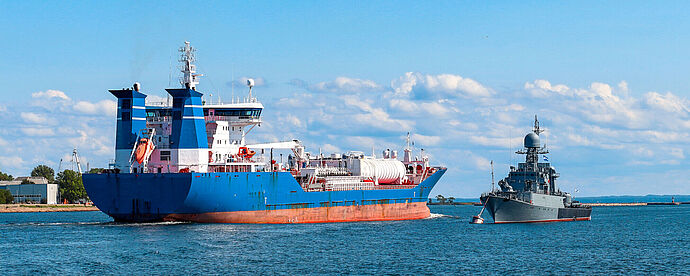
In the field of ‘Politics & Security’, researchers are analysing geopolitical dynamics and challenges to security policies in the Baltic Sea region – from the energy infrastructure to military cooperation. Activities focus on the region’s understanding of its geopolitical significance for transnational collaboration and conflict solving.

In the field of ‘Democracy and Society’, researchers are examining social structures and democratic processes in the Baltic Sea region, with a special focus on rural regions. Participation, critical infrastructures, and new forms of entrepreneurship and political engagement are key factors in strengthening the resilience of democratic systems.

In the field of ‘Culture and Heritage’, researchers are investigating the cultural diversity of the Baltic Sea region in both the past and present. They are analysing material witnesses from jewellery to architecture as well as immaterial values, narratives, and traditions in order to make regional identities visible.
Projects
The research into the Baltic Sea region is based on inter-institutional research projects that were awarded in competitive funding calls and perform fundamental research, foster the creation of networks, provide innovative teaching, and facilitate the broad dissemination of research results to society.
- Fragmented transformations. Perceptions, Constructions and Contexts of a Region in Transition (BMBF)
- IRTG Baltic Peripeties. Narratives of Reformations, Revolutions and Catastrophes (DFG)
- Research Centre for Manors in the Baltic Sea RegionWKM & BKM)
- Young People’s Network for Balticness (PSF, Council of the Baltic Sea States)
- Openspaces (DAAD)
- MAGnituDe (EU-Horizon)
Degree courses
- Baltic Studies B. A. [de]
- Finnish Studies B.A. [de] / Finnish Studies M.A. [de]
- History B.A. [de] / History M.A. [de]
- Culture - Interculturality - Literature M.A. [de]
- History of Art, B.A. [de] / History of Art, M.A. [de]
- Political Science B.A. [de] / Political Science M.A. [de]
- Scandinavian Studies B.A. [de] / Scandinavian Studies M.A. [de]
- Slavonic Studies B.A. [de] / Slavonic Studies M.A. [de]
- Language Diversity. Linguistics of English, Baltic, Finnish, Scandinavian, and Slavic Cultures M.A. [de]
Central Facilities
Partner institutions
Approaching central research topics, we join forces with leading partner institutions – in the Baltic Sea region, in Germany, and across the globe – to gain new insights and find solutions that will be relevant to society. Collaborations with decision-makers and relevant institutions from the worlds of politics, administration, and civil society provide special added value.
NTNU – Norwegian University of Science and Technology
Södertörn University, Centre for Baltic and East European Studies (CBEES)
Tallinn University, Centre for Landscape Studies
UiT The Arctic University of Norway
University of Gdańsk, Institute of Scandinavian and Finnish Studies, International Border Studies Centre (IBSC)
University of Szczecin
University of Tartu
Alfried Krupp Wissenschaftskolleg Greifswald (Institute for Advanced Studies)
Association for the Advancement of Baltic Studies (AABS)
Institute for Climate Protection, Energy and Mobility (IKEM)
Leibniz Institute for the History and Culture of Eastern Europe (GWZO)
Leibniz Institute for Baltic Sea Research Warnemünde (IOW)