You should bring the following skills with you
To succeed in your studies, an interest in physics, combined with the ability to engage in modelling and theoretical analysis, as well as experimental skills, are essential. In addition, the bachelor’s degree in physics should have been completed with good results.
This subject is about
As a postgraduate programme, the master’s degree course explores key concepts and laws of modern physics in greater depth, further develops experimental and theoretical methods, and ultimately introduces students to current research in physics. On this foundation, students develop the ability to think and work independently in a scientific context and are equipped with the skills to make scientifically-based contributions to their future professional fields. Successful graduates of the degree course will be able to explain physical phenomena, critically assess scientific issues and address them using modern experimental and theoretical methods.
In addition to building on their general knowledge of physics in advanced experimental and theoretical courses, students can start to specialise their skills in two areas of specialisation. At present, Greifswald offers specialisations in three areas of physics: plasma physics, atomic and solid-state physics (quantum physics) and soft matter, biophysics and environmental physics, medical physics.
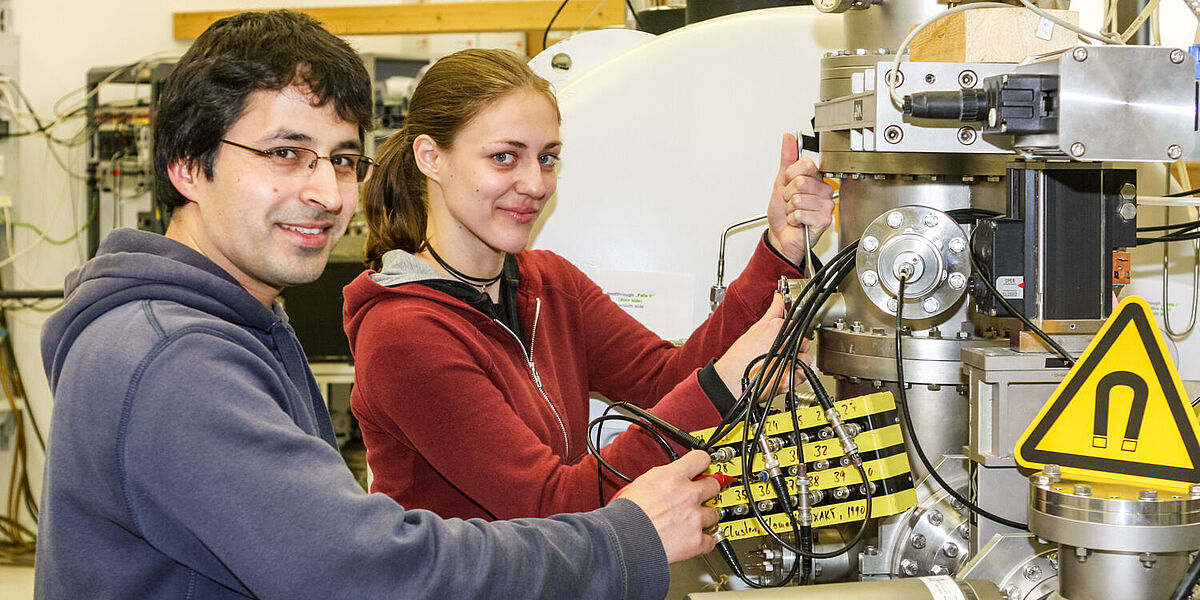
In the second semester, students choose one of the two areas of specialisation and, in addition to attending lectures, complete a laboratory internship in the research groups. This provides an introduction to the current research topics being investigated by the respective groups. Students then write their master’s thesis in the chosen area of specialisation, which involves planning, preparation and completion within two semesters. The thesis is defended at a colloquium.
The Institute of Physics offers specialisation opportunities in cutting-edge and forward-looking research at the following groups: Low-Temperature Plasma Physics, Colloidal Plasmas, Atomic and Molecular Physics, Interface and Surface Physics, Soft Matter, Computational Sciences, Environmental Physics, Condensed Matter Theory, Complex Quantum Systems and Theory of Soft Matter. Plasma physics has historically been a key area of focus.
In addition to the University’s Institute of Physics, the master’s thesis may also be completed at the Max Planck Institute for Plasma Physics, Greifswald Branch, or at the Leibniz Institute for Plasma Science and Technology. The intensive and personalised support provided by staff at the Institute of Physics’ individual research groups ensures that students complete their studies within the standard length of study.
Graduates of this field work in...
A degree in physics opens up a wide range of career opportunities. These include the technical sectors of the economy, such as electronics and electrical engineering, as well as communications technology, medical technology and environmental technology. Furthermore, research into physical problems in the narrower sense is performed at public and private research institutions. Suitable graduates may follow up their degree studies with independent research work that can culminate in the completion of a doctorate (Dr. rer. nat.). The physics institutes in Greifswald offer specific opportunities in this regard, including involvement in their graduate schools and research consortia.
General information on the degree course
Admission to the master’s degree course requires the successful completion of a scientific bachelor’s degree in physics (university degree); any exceptions to this requirement are decided by the Institute of Physics’ Examination Committee. There are no entry restrictions for this four-semester degree course. Compared to the bachelor’s degree course, the master’s degree course provides further specialisation in the subject area and a more in-depth scientific examination of a current research topic as part of a master’s thesis, leading to the award of a Master of Science in Physics (M.Sc. in Physics).